


Everyone is a Magento expert until they inherit someone else’s codebase, the ERP stops syncing, an extension breaks after an upgrade, and Friday’s release suddenly gets interesting. Choose the agency that can tell you what happens next.
Step-by-Step Guide: How to Choose the Right Magento Development Agency in the U.S.
Everyone is a Magento expert until they inherit someone else’s codebase, the ERP stops syncing, an extension breaks after an upgrade, and Friday’s release suddenly gets interesting. Choose the agency that can tell you what happens next.
TL;DR
Look for proof, not Magento logos. Ask what the agency actually built, migrated, integrated, or took over.
Make them talk about the messy parts. Existing code, custom modules, ERP integrations, technical debt, and unknowns are where expertise really shows.
Evaluate the delivery system, not just the developers. QA, testing, releases, documentation, communication, and ownership matter.
Compare the cost of delivery, not hourly rates. Cheap development gets expensive quickly when it creates rework, maintenance problems, or unpredictable scope.
Ask what happens when things go wrong and after launch. A strong partner should have a clear answer to both.
Your Magento Agency Will Own More Than Code
Choosing a Magento development agency means handing an external team responsibility for a platform connected to revenue, customer experience, payments, inventory, fulfillment, and often several other business-critical systems.
Technical expertise matters, but it is only part of the decision. A strong partner should also give you visibility into what is happening, identify risks before they become expensive, communicate clearly when assumptions change, and take responsibility for the quality of delivery.
That is also how we approach Magento projects at Polcode: giving clients visibility into where the project stands, what comes next, and what risks or decisions need their attention.
The following steps can help you evaluate Magento development companies through that same lens.
1. Start With What You Actually Need From a Magento Agency
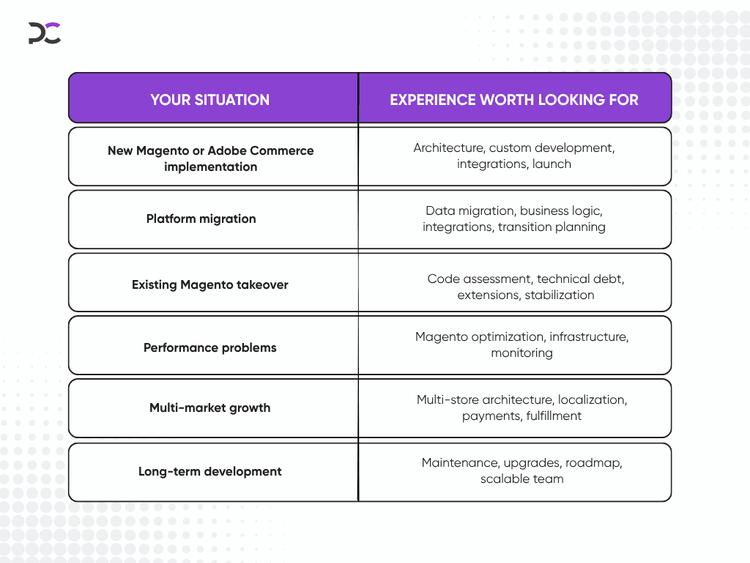
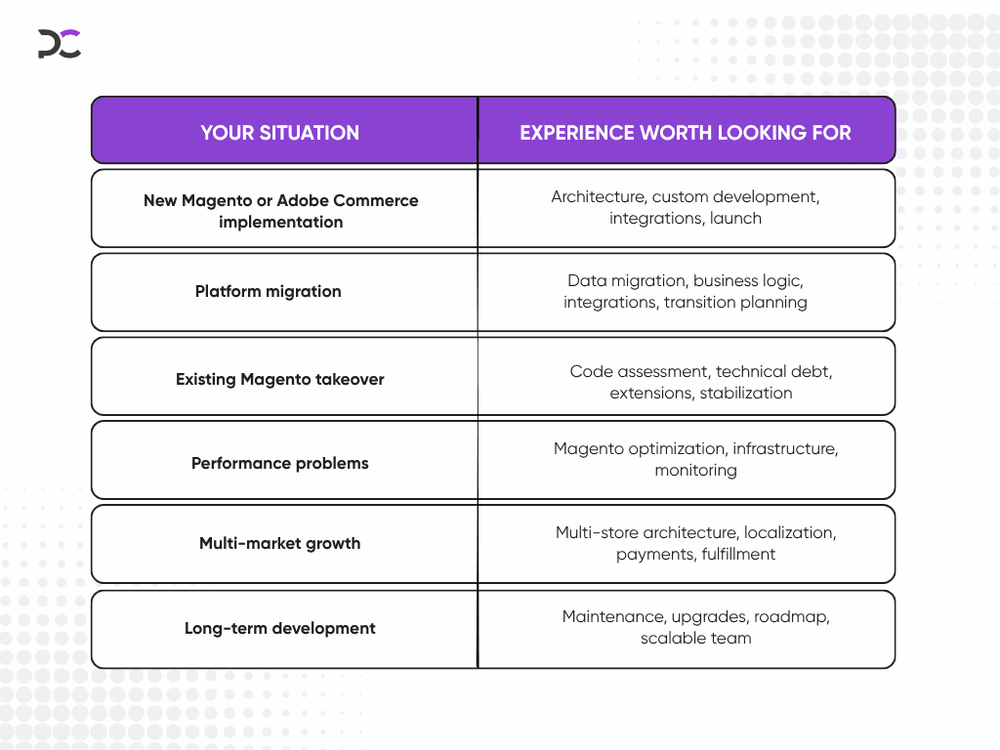
Before comparing agencies, define the problem you need them to solve. Relevant Magento experience can look very different depending on whether you are building a new store, migrating an established business, or handing an existing platform to a new development partner.
If you are still deciding whether Magento is the right platform for your next stage of growth, make that decision first. The value of Magento tends to increase as e-commerce becomes more closely connected to proprietary business logic, complex integrations, specialized B2B workflows, or differentiated operations across markets.
Our Magento vs Shopify Guide for U.S. Mid-Market Brands looks at that decision in more detail.
This distinction matters because Magento projects become particularly demanding when the platform needs to support high traffic, multiple stores or markets, custom workflows, and integrations with the systems running the rest of the business.
A company that has delivered straightforward Magento storefronts may therefore have very different capabilities from one that has migrated complex stores, inherited custom code, or integrated Magento with ERP, CRM, PIM, OMS, payment, and logistics systems.
2. Verify Magento Expertise With Evidence
Magento expertise should be easy to demonstrate.
Certifications are a useful signal, but certifications should sit alongside evidence from real projects.
When reviewing case studies, go further than counting Magento logos. Ask what the agency was actually responsible for.
Did the team build the platform? Did they migrate it? Which integrations did they implement? Did they create custom business logic? Did they inherit code written by another vendor? Did they remain responsible after launch?
A recent Polcode project for UK construction supplier Benx is a useful example of what relevant experience can involve. The work included a Magento 2 platform integrated with Sage ERP, stock information across four regional warehouses, different B2B customer types, click-and-collect and delivery workflows, and a custom product calculator based on real construction rules.
The value of that case goes beyond “we built Magento.” It shows the ability to translate specific business workflows into ecommerce functionality.
That distinction should guide your own vendor evaluation.
Ask: Can you show us a Magento project similar in complexity to ours and explain exactly what your team owned?
3. Find Out How They Handle Existing Complexity
Many companies searching for Magento development services already have a functioning store already. It may also contain years of custom development, third-party extensions, undocumented decisions, integrations, technical debt, and outdated dependencies.
In that situation, one of the most useful questions you can ask is:
How do you assess what you are inheriting before you recommend major changes?
A technical assessment or code audit can reveal architectural problems, performance bottlenecks, maintainability risks, vulnerable dependencies, and parts of the codebase that may complicate an upgrade or migration.
This becomes particularly important with extensions and custom modules. Compatibility, maintainability, security, and future upgrades all need to be considered before existing functionality is carried forward.
Polcode encountered this type of challenge while modernizing the Magento platform for Ouderwetsewinkel, a Dutch retailer with a long-established ecommerce operation. The upgrade involved third-party extension compatibility, infrastructure checks, backups, a mirror testing environment, database work, functionality testing, and post-release performance monitoring.
That is a very different task from installing a clean Magento instance.
Be cautious when an agency confidently estimates a complicated takeover, migration, or upgrade before properly examining the existing platform and its dependencies.
4. Test Their Technical Depth Beyond Magento
For mid-market and enterprise ecommerce, Magento rarely works alone.
The platform may exchange data with ERP, CRM, PIM, warehouse and order-management systems, payment providers, shipping services, analytics tools, and marketing platforms. The quality of those connections can have as much impact on daily operations as the storefront itself.
A capable Magento 2 ecommerce development company should therefore be able to discuss data flows, synchronization, system ownership, failure scenarios, and the operational consequences of an integration becoming unavailable.
You should also ask how the team chooses between native Magento functionality, an existing extension, and custom development.
Custom Magento ecommerce development can be extremely valuable when business requirements genuinely demand it. It also creates code that must be secured, tested, documented, maintained, and kept compatible with future platform changes.
A strong Magento partner should be comfortable explaining why a customization is worth owning over the long term.
5. Evaluate the Delivery System Around the Developers
Experienced Magento developers are important. So are the processes that make their work consistently reliable.
Ask what happens between development and production:
How is code reviewed?
How are integrations tested?
Which tests are automated?
How are releases validated?
How is documentation maintained?
Who monitors what happens after deployment?
These processes become especially important as projects grow. They reduce dependence on individual developers and make quality part of the delivery system rather than something the client has to supervise personally.
They are becoming even more important as AI and automation change software delivery. Development speed alone tells you less about the value of an agency when tooling can accelerate parts of the engineering process. Methodology, quality assurance, governance, and the ability to deliver predictable outcomes matter alongside technical skill.
🔗 Agencies of the Future Will Sell Systems, Not Hours
A client should not need to continually check whether quality processes exist or wonder whether a problem has been noticed. The delivery model should create that visibility by design.
6. Pay Attention to How the Agency Works With You
You can learn a surprising amount about a Magento agency before the first line of code is written.
Pay attention to the questions its team asks during discovery.
A serious partner may want to understand your current architecture, catalog, traffic patterns, customer groups, markets, integrations, custom workflows, extensions, operational constraints, and plans before recommending an approach.
They should also be willing to tell you what they do not know yet.
That matters because false certainty creates risk. If important technical unknowns remain, a precise estimate may simply hide assumptions that will surface later as scope changes or additional costs.
For U.S. companies working with an international Magento development company, communication deserves the same scrutiny as technical expertise. Time-zone overlap matters, but so do direct access to the right people, clear escalation paths, continuity, documentation, and responsiveness when decisions are needed.
This is where nearshore teams in Europe can be attractive to U.S. businesses: they can combine access to specialized engineering talent with meaningful working-hour overlap. Geography alone, however, cannot compensate for weak communication or delivery practices.
Evaluate how the partnership will actually work day-to-day.
7. Compare Delivery Economics, Not Only Hourly Rates
Cost matters, especially when comparing U.S., nearshore, and offshore Magento development companies. Hourly rates can vary significantly between markets.
They are still only one input into the cost of delivery.
A lower development rate provides little advantage if unclear requirements create extensive rework, poor architecture increases maintenance costs, or every change produces another round of unplanned billing.
When comparing proposals, consider scope and assumptions, team composition, QA, change management, maintenance responsibilities, and expected long-term ownership costs, not simply developer rates.
A productive team with better automation and stronger processes may also require fewer hours to achieve the same result.
The useful comparison is therefore closer to total delivery economics than a simple rate card.
🔗 Agencies of the Future Will Sell Systems, Not Hours
8. Check What Happens After Launch
Magento development rarely ends at go-live.
Platforms need security updates, extension maintenance, performance monitoring, infrastructure work, feature development, compatibility checks, and eventually larger upgrades.
Before choosing an agency, establish what long-term ownership looks like.
Who monitors the platform? How are incidents handled? How quickly can the team respond? How will technical debt be managed? Who plans future upgrades? Can development capacity increase when the business needs it?
The Puccini ecommerce project illustrates why continuity matters. Polcode took over an existing store from previous developers and continued developing the platform across performance, business logic, checkout UX, logistics, international selling, marketing, and analytics.
The client originally wanted a reliable, timely, and trusted ecommerce development company that could take responsibility for the maintenance and continued development of the store. The cooperation subsequently developed into a multi-year technology partnership.
That kind of experience can be particularly relevant when you expect Magento to keep evolving with the business.
Magento Agency Red Flags to Watch For
A few signals should prompt additional questions during vendor evaluation:
A complex migration or takeover is estimated without examining the existing platform.
Case studies mention Magento but provide little detail about what the agency actually delivered.
Custom development is proposed without discussing native functionality or existing solutions.
ERP, CRM, PIM, OMS, payments, or logistics integrations are treated as secondary concerns.
The agency cannot clearly explain its code review, QA, testing, and release processes.
Proposal assumptions and scope boundaries are difficult to identify.
Price comparisons focus primarily on hourly rates.
Post-launch responsibilities remain unclear.
One red flag does not automatically disqualify a vendor, but unexplained uncertainty should be investigated before signing a long-term agreement.
Questions to Ask a Magento Development Agency Before You Hire Them
Bring questions like these to your vendor conversations:
Can you show us a Magento project similar in complexity to ours and explain exactly what your team delivered?
How would you assess our existing platform before recommending major changes?
How do you decide between native Magento functionality, extensions, and custom development?
How do you approach ERP, CRM, PIM, OMS, payment, and logistics integrations?
What are your code review, testing, and release processes?
Who would actually work on our project, and who would be responsible for delivery?
How do you handle changes in scope, technical unknowns, and estimation risk?
What happens after launch?
What do you currently see as the biggest technical or delivery risk in the project we have described?
The last question is particularly useful. A good prospective partner should already be thinking about where your project could become difficult and how those risks can be reduced.
Choose a Magento Partner That Makes the Platform Easier to Own
The right Magento development agency should leave you with less uncertainty to manage.
You should understand what is being built, where the risks are, how decisions affect the budget, and what happens next. When problems appear, you should hear about them early and understand the plan for resolving them.
If you are evaluating Magento development services for a new implementation, migration, existing platform takeover, or long-term ecommerce development, talk to Polcode about your project.
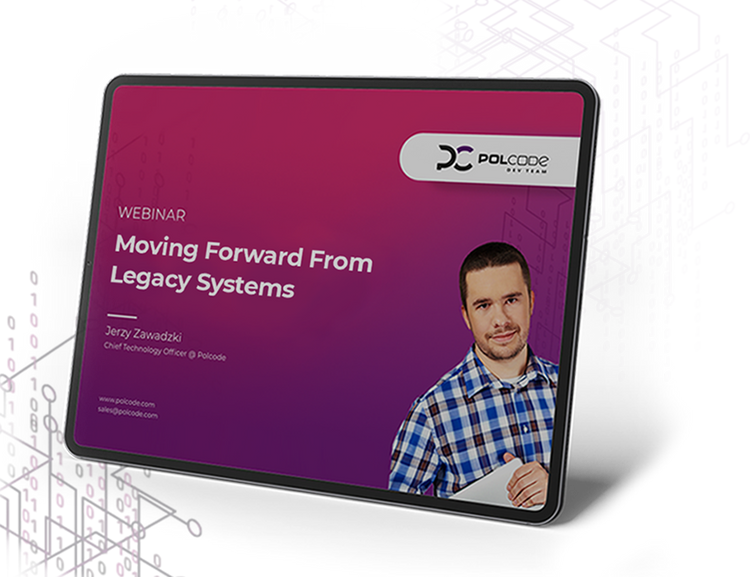
On-demand webinar: Moving Forward From Legacy Systems
We’ll walk you through how to think about an upgrade, refactor, or migration project to your codebase. By the end of this webinar, you’ll have a step-by-step plan to move away from the legacy system.
Latest Blog Posts
Headless Magento: When (and When Not) to Go Headless
Sep 23, 2026 by Dariusz Sadkowski
Magento vs Shopify for U.S. Mid-Market Brands: Which Platform Wins in 2026?
Sep 16, 2026 by Szymon Włodarski
When Modern Frontends Matter: How React, Vue, and Angular Help Replace Slow, Hard-to-Maintain Interfaces
Sep 2, 2026 by Konrad Bolek
Your Magento Platform Deserves More Than “Good Enough”
Tell us what you’re working with
New build, migration, inherited codebase, performance issues, integrations, or a platform that has simply become harder to manage.
We’ll look at where the real complexity is
Our team will help identify technical unknowns, dependencies, risks, and the decisions that matter before recommending an approach.
Build with a team that takes ownership
Get the Magento expertise, delivery processes, and long-term support needed to keep your platform moving with your business.