


Shopify for smaller brands. Magento for bigger ones. Nice, simple, and increasingly useless. In 2026, the smarter question is what kind of complexity your business is building and whether you want your e-commerce platform to absorb it, accommodate it, or make you pay for it later.
Magento vs Shopify for U.S. Mid-Market Brands: Which Platform Wins in 2026?
Shopify for smaller brands. Magento for bigger ones. Nice, simple, and increasingly useless. In 2026, the smarter question is what kind of complexity your business is building and whether you want your e-commerce platform to absorb it, accommodate it, or make you pay for it later.
Magento vs Shopify: Start With Complexity, Not Company Size
For a growing e-commerce brand, choosing a platform rarely starts with a blank sheet of paper. There is usually already a store, customer data, integrations, payment and fulfillment processes, and years of decisions embedded in the existing setup.
For U.S. mid-market brands generating roughly $5–50 million in annual revenue, Shopify, Magento Open Source, and Adobe Commerce are credible options in 2026.
Shopify has expanded well beyond straightforward DTC commerce, with stronger international, B2B, and platform extensibility capabilities. Magento Open Source and Adobe Commerce continue to offer extensive control over storefronts, catalogs, integrations, pricing, and commerce logic.
That makes the usual feature-by-feature comparison increasingly unhelpful.
A more useful question is:
How much ecommerce complexity should your platform absorb, and how much control does your business actually need?
Understanding where that complexity comes from is a better starting point for a Magento vs Shopify decision than revenue, SKU count, or traffic alone.
Shopify vs Magento: Start With the Operating Model
The fundamental difference between Shopify and Magento becomes clearer when we look at who is responsible for running and evolving the commerce platform.
Shopify is hosted SaaS. Hosting, core infrastructure, platform-level security, and much of the ongoing maintenance sit within the Shopify environment. Merchants configure the platform, add applications and integrations, and customize customer experiences without operating the underlying ecommerce application themselves.
Magento follows a different model, although an important distinction is often lost in comparisons: Magento Open Source and Adobe Commerce are not interchangeable products.
Magento Open Source gives businesses considerable freedom to host, modify, and extend the ecommerce application. Adobe Commerce adds commercially licensed capabilities, including advanced B2B functionality, additional enterprise-oriented features, and deployment options. In both cases, greater architectural freedom can mean greater engineering responsibility, depending on the setup.
That responsibility matters over the lifetime of a store. Magento environments require attention to areas such as upgrades, extensions, integrations, performance, and security.
🔗Magento vs. The Competition – The Benefits of Migrating to Magento 2
This gives us the first decision question:
Does owning more of your commerce architecture create enough business value to justify owning more of its technical complexity?
What “Scaling” Actually Means for a Mid-Market Ecommerce Business
Scalability is one of the most common arguments in Magento vs Shopify comparisons, but it means very little until we define what is actually scaling.
Consider two retailers generating $20 million annually.
The first sells DTC primarily in the United States. It has a relatively stable catalog, standard pricing, one fulfillment model, and conventional marketing and payment integrations.
The second operates in several countries, sells B2C and B2B, maintains inventory across multiple warehouses, synchronizes orders and pricing with an ERP, uses market-specific catalogs, and has proprietary rules governing how some products are configured and sold.
Their revenue is identical. Their commerce complexity is completely different.
Mid-market growth can increase transaction volume, but it can also add markets, warehouses, fulfillment models, B2B requirements, integrations, and proprietary business logic.
For Benx, the complexity sits deeper in operations. Its Magento environment integrates with Sage ERP, synchronizes products, inventory, pricing, and orders, supports four regional warehouses, and serves B2B and trade customers. It also incorporates custom product-calculation logic based on the company's business rules.
This example reveals an important distinction:
Mid-market scale often looks less like twice as much traffic and more like twice as many dependencies.
The better scalability question is therefore:
How different will our e-commerce operations become as we grow?
In practice, Magento becomes particularly compelling when regional or business-unit differences require different catalog structures, pricing models, customer rules, checkout behavior, integrations, or custom application logic. If markets are largely standardized and mainly require localization, currencies, and conventional international selling capabilities, Shopify can be a strong alternative.
When Business Complexity Changes the Platform Decision
An e-commerce platform assessment should therefore map which data moves between systems, which system owns it, what happens when synchronization fails, and which processes are revenue-critical.
🔗 Signs Your E-Commerce Business Needs a Platform Migration
This is also where a simplistic “Shopify relies on apps, while Magento allows customization” comparison breaks down.
Shopify provides APIs, apps, Functions, and other extension mechanisms for customizing commerce behavior, while Magento provides deeper control over the underlying application architecture.
A standard integration that can be installed and maintained through the Shopify ecosystem may be considerably cheaper than building custom functionality. The economics change when e-commerce needs to reflect something proprietary about the business.
In 2026, Shopify B2B is available on Basic, Grow, Advanced, and Shopify Plus plans, although the depth of functionality varies by plan. Features available across plans include companies, catalogs, net payment terms, self-service ordering, and Shopify Flow automation, while capabilities such as direct company catalogs and certain advanced payment workflows require Shopify Plus.
Source: Shopify B2B features by plan
Adobe Commerce still offers deep B2B workflows, including company accounts, company hierarchies, shared catalogs, negotiable quotes, and purchase-order workflows.
Source: Enable B2B features
A company needing conventional B2B pricing and catalogs faces a different problem than one requiring specialized purchasing hierarchies, negotiated workflows, ERP-driven pricing, or proprietary approval rules that fall outside the platform's native model and extension capabilities.
Customization follows the same logic. Greater freedom has value when it supports processes that differentiate or enable the business. Otherwise, it can create more software to test, secure, document, and upgrade.
This is why Polcode's Magento migration guidance recommends reviewing existing modules and scripts rather than automatically recreating everything during a replatform. Some functionality may be obsolete, redundant, or better rebuilt as a proper integration.
🔗 Magento: To Migrate or Not to Migrate, That Is the Question
🔗 M1 to M2 Migration from Senior Magento Developer’s Perspective
Magento 1 to Magento 2 migrations are a particularly useful example of this problem. A legacy Magento store can accumulate years of custom modules, third-party extensions, database changes, integrations, and business-specific logic. Moving to Magento 2 is therefore not simply a matter of upgrading the platform or reproducing the existing implementation one-to-one.
A successful migration requires deciding what to migrate, what to rebuild, what to replace with a standard platform capability or integration, and what to retire altogether. The technical challenge is often not moving the data itself, but determining which historical decisions are still worth carrying into the new architecture.
Migrations in both directions offer useful evidence as well. Some businesses move away from SaaS when custom functionality or operational requirements justify greater control. Others leave Magento because maintenance and engineering dependency have become disproportionate to the value that flexibility provides.
Technical flexibility is valuable, but every customization becomes a potential future maintenance or migration responsibility. The goal should therefore not be to preserve every existing customization, but to preserve the business capability that still creates value.
The strongest case for deeper architectural control is usually not the existence of a custom requirement by itself, but the need to implement that requirement as part of the core commerce architecture rather than as an external application, integration, or constrained extension.
This becomes particularly relevant when e-commerce is tightly connected to proprietary business processes. Examples include dynamic pricing based on customer contracts, product configuration that requires custom calculations, complex inventory allocation across multiple warehouses, or ERP-driven order and fulfillment workflows.
A simple ERP integration that synchronizes products, inventory, and orders does not necessarily require Magento. The situation changes when the commerce platform must actively participate in the business logic—for example, applying proprietary pricing rules, validating orders against external data, or coordinating complex fulfillment processes.
This is where Magento's deeper architectural flexibility can provide real value. However, the additional freedom also means more code to maintain, test, secure, and upgrade.
The practical question is therefore not:
“Can Magento be customized to do this?”
but:
“Does this business requirement justify making the commerce platform responsible for this logic?”
When the logic is proprietary, transaction-critical, and difficult to implement through standard extension mechanisms, Magento's deeper architectural control can become a meaningful advantage.
Magento vs Shopify Cost: Think in 3–5 Years, Not Month One
Platform fees are among the easiest ecommerce costs to compare and among the easiest to overvalue.
Shopify provides a relatively visible subscription starting point. Apps, development, payment processing, and integrations then add to that cost.
Magento Open Source does not carry an equivalent SaaS subscription, but running it is not free. Infrastructure, implementation, development, monitoring, security, upgrades, and maintenance have to be paid for somewhere. Adobe Commerce adds its own commercial pricing.
For a mid-market company, the useful TCO comparison looks more like this:
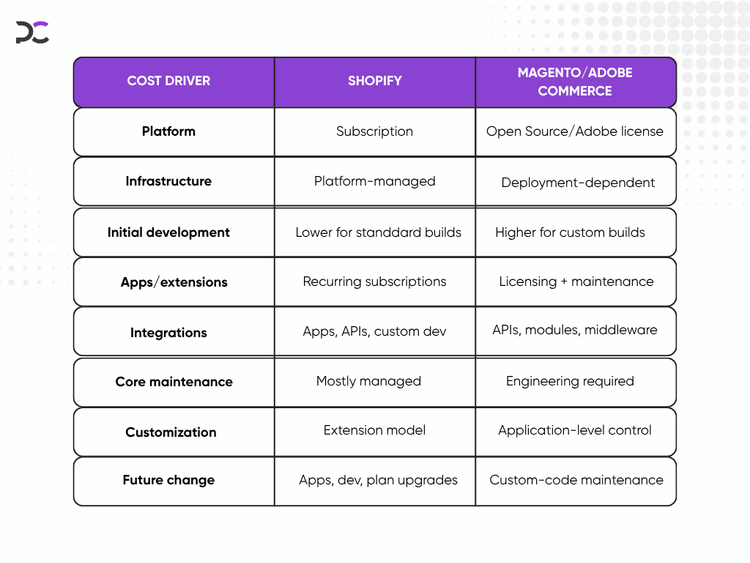
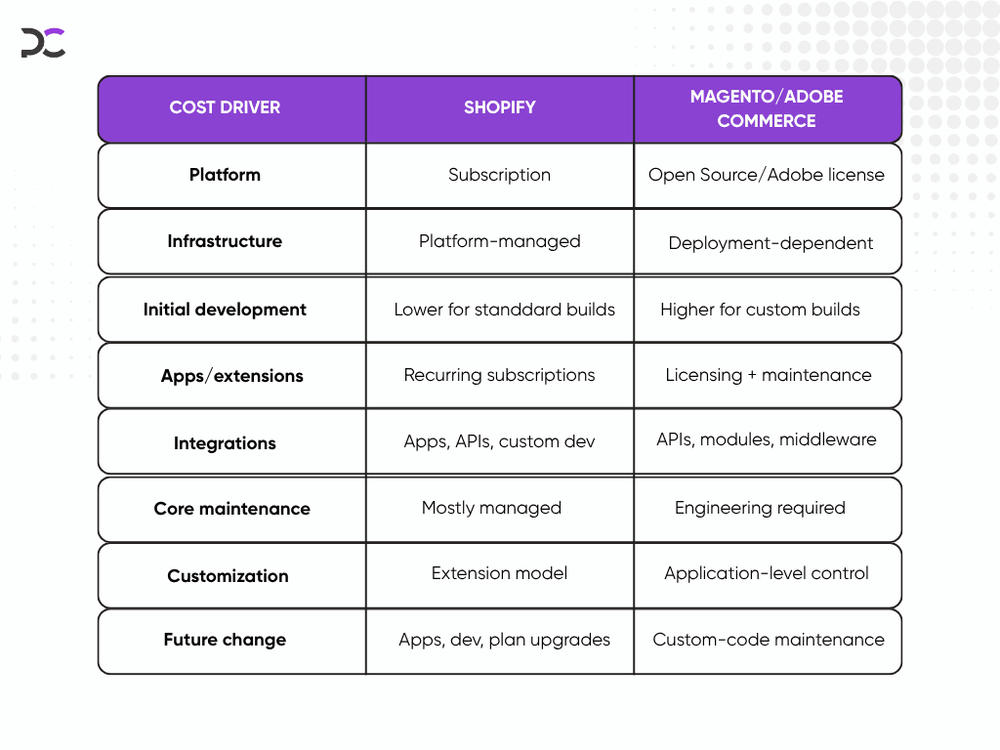
Even this table cannot tell us which platform will cost less.
A relatively standard retailer could spend far more maintaining a customized Magento environment than it ever recovers from Magento's additional flexibility. A company repeatedly building workarounds around SaaS constraints can face the opposite problem.
This leads to a cost that conventional TCO calculations often miss:
The cost of change
Imagine that both platforms meet 95% of a retailer's requirements today.
What happens if the remaining 5% becomes business-critical two years from now?
With Shopify, costs may increase when a requirement cannot be addressed efficiently through the platform's native capabilities and extension model and instead requires additional apps, middleware, custom development, a higher plan, or changes to the intended process.
Magento creates another kind of risk. Because businesses can customize more deeply, they can accumulate modules, integrations, and proprietary logic. Poorly governed customization can make upgrades and future development increasingly expensive.
Both platforms can therefore create forms of lock-in.
Shopify creates greater dependency on the capabilities, APIs and commercial evolution of the SaaS platform. Magento can create dependency on the architecture and custom code a company has built for itself.
Owning code that is expensive to understand and change provides little strategic advantage.
Control has a cost. Constraints have a cost too.
The real TCO question is which one your business is more likely to pay over the next three to five years.
The Magento costs businesses most often underestimate are not limited to hosting. They can include ongoing upgrade work, extension compatibility, custom-code maintenance, performance engineering, security work, monitoring and observability, deployment infrastructure, and the cost of retaining developers who understand the application's custom architecture. The exact balance depends heavily on how much the implementation has diverged from the platform's standard behavior.
There is also a third option: not replatforming at all. If the existing platform supports the business requirements, performs reliably, and does not create a material barrier to growth, the cost and risk of migration may outweigh the benefits of changing platforms. Replatforming should solve a business or architectural problem, not simply replace one platform with another.
Shopify or Magento? A Decision Framework for Mid-Market Brands
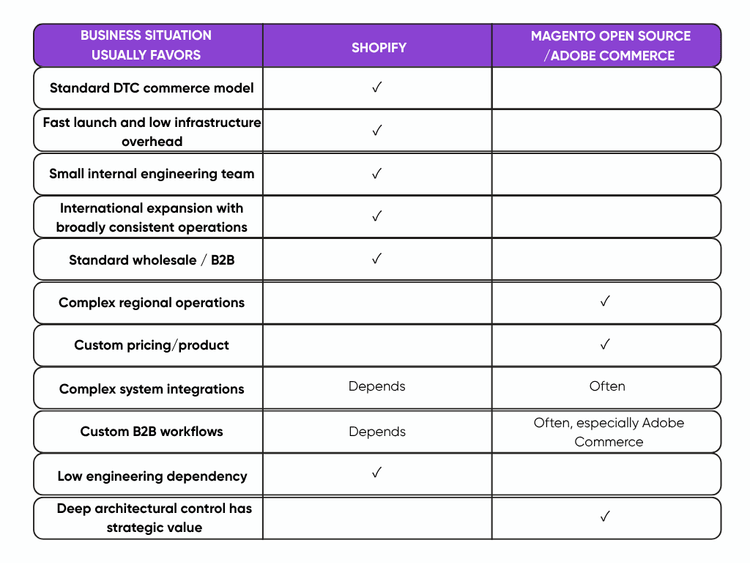
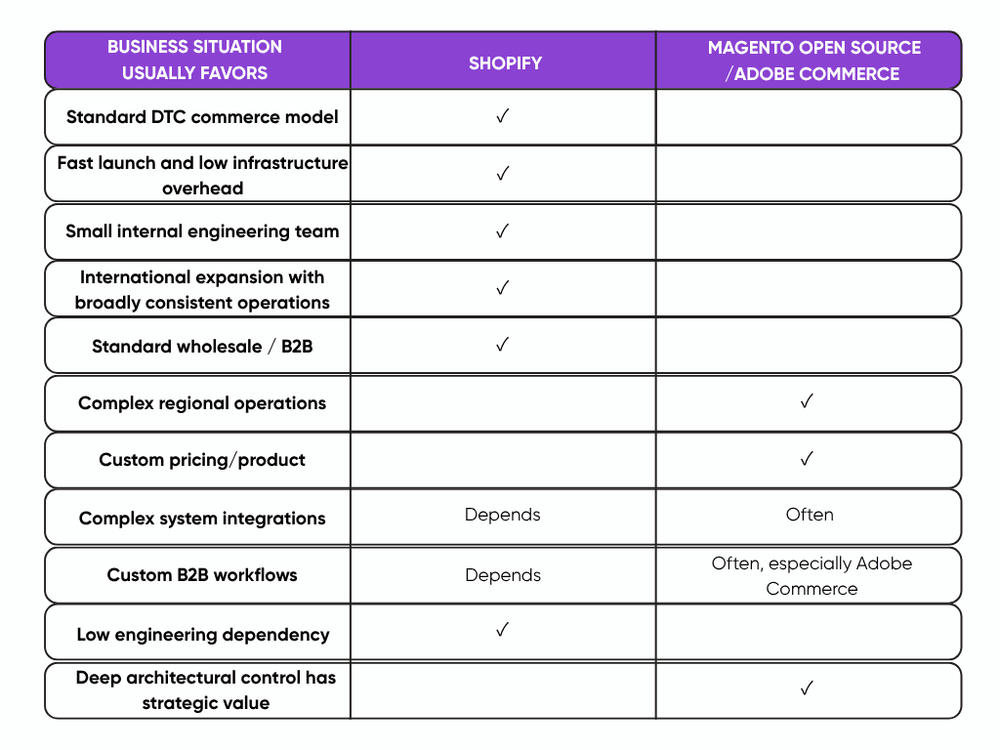
The word usually matters. No table can model a company's architecture.
The decision should therefore start with five questions:
Where does our ecommerce complexity come from today?
What new complexity are we likely to introduce over the next three to five years?
Which parts of commerce genuinely differentiate our business?
Which platform constraints can we comfortably accept?
How much engineering responsibility can we sustainably own?
The last question is particularly important for Magento.
Does Nearshore Development Change the Magento Equation?
Magento's engineering requirements are easier to sustain when a business has reliable long-term access to specialized developers.
For U.S. mid-market companies, this means the development model can influence the platform economics. A long-term nearshore team can combine Magento expertise with working-hour overlap and ongoing development and maintenance at a different cost structure than that of a fully U.S.-based specialist team.
Polcode's work with Peter Christian illustrates why this matters. The retailer's e-commerce environment required work around performance, infrastructure, security, and Magento itself, particularly during high-demand periods. Outdated modules, caching, infrastructure, and security all required active attention.
A business choosing Magento without a realistic plan for maintaining it is making only half of the platform decision.
We would recommend Shopify when the business benefits more from reducing platform ownership and engineering overhead than from having deep control over the underlying commerce application.
This can apply even to relatively sophisticated mid-market businesses. A primarily DTC brand with a standardized catalog, conventional pricing and fulfillment, and a small engineering team may be better served by Shopify. Similarly, international expansion alone is not a strong reason to choose Magento if markets mainly require different currencies, languages, domains, and localized content.
The same applies to standard B2B and ERP/OMS/WMS integrations. If requirements can be handled through Shopify's native capabilities, apps, APIs, or middleware, Magento's deeper customization may not provide enough additional value to justify the maintenance burden.
We would therefore favor Shopify when the business model is relatively standardized, engineering resources are limited, and minimizing infrastructure and maintenance responsibility is a priority.
The key question is not simply “Can Shopify support our requirements?”, but:
“Can Shopify support them without creating an unnecessarily complex or expensive architecture?”
If the answer is yes, Shopify may be the better choice, even for a technically sophisticated mid-market business.
Conclusion: Choose for the Complexity You Expect
There is no useful 2026 answer in which Shopify is simply for smaller companies, and Magento is for larger ones.
Shopify can support sophisticated mid-market businesses while absorbing much of the infrastructure and platform maintenance burden. Magento Open Source and Adobe Commerce provide deeper architectural control that becomes valuable when e-commerce needs to reflect proprietary integrations, workflows, pricing structures, or operating models.
For a mid-market brand, the decision therefore requires looking beyond today's revenue, catalog, and traffic and mapping the business it expects to operate several years from now.
The goal is to avoid paying for complexity you do not need today without creating a ceiling you are likely to hit tomorrow.
Evaluating Magento or Shopify for Your Next Stage of Growth?
Before committing to a platform or replatforming project, map your integrations, custom logic, expected growth, and long-term ownership requirements.
Polcode's ecommerce and Magento specialists can help assess the technical feasibility and likely cost of different paths before you commit to a rebuild.
FAQs
Is Magento better than Shopify for mid-market companies?
It depends on where the company's complexity sits. Shopify can be a strong choice for businesses that want to minimize infrastructure and maintenance responsibility while operating within a relatively standardized commerce model. Magento Open Source or Adobe Commerce becomes more compelling when proprietary logic, complex integrations, or specialized workflows make deeper architectural control valuable.
How much does it cost to switch from Shopify to Magento?
There is no reliable flat migration price. Data migration, integrations, themes, custom functionality, extensions, infrastructure, testing, and business continuity all affect the scope. Existing functionality should also be reviewed rather than automatically recreated on the new platform.
Which platform supports more integrations?
Both have extensive ecosystems and APIs. The more useful question is how much customization an integration requires. Shopify can make common integrations fast and economical through its ecosystem, while Magento Open Source and Adobe Commerce provide greater freedom when integrations need to interact deeply with proprietary application logic or the underlying commerce architecture.
Can U.S. businesses work with Magento developers overseas?
Yes. For Magento in particular, long-term access to specialized engineering talent can materially affect ownership costs. Companies should evaluate technical expertise, communication, working-hour overlap, security practices, and maintenance capability alongside rates.
Which e-commerce platform offers the best ROI for scaling brands?
It depends on what is scaling. Increasing traffic and transaction volume does not necessarily require greater architectural ownership. Growth that introduces complex integrations, markets, pricing models, or proprietary workflows can make additional control considerably more valuable.
On-demand webinar: Moving Forward From Legacy Systems
We’ll walk you through how to think about an upgrade, refactor, or migration project to your codebase. By the end of this webinar, you’ll have a step-by-step plan to move away from the legacy system.
Latest Blog Posts
Step-by-Step Guide: How to Choose the Right Magento Development Agency in the U.S.
Sep 11, 2026 by Michał Koziorowski
When Modern Frontends Matter: How React, Vue, and Angular Help Replace Slow, Hard-to-Maintain Interfaces
Sep 2, 2026 by Konrad Bolek
Better Prompts Start With Better Context
Aug 25, 2026 by Michał Hossien
Before You Pick a Platform, Map the Complexity
Map what you have
Review your current platform, integrations, custom logic, workflows, and the dependencies your business already relies on.
Model what’s coming
Look at the next three to five years: new markets, B2B, pricing models, fulfillment, integrations, and other requirements that could change your ecommerce architecture.
Choose what’s worth owning
Decide where deeper control creates real business value and where a platform that absorbs more technical responsibility makes more sense. Polcode can help you assess the options before you commit to a migration or rebuild.