


Your customers don’t care how many layers your commerce stack has. They care whether the experience works. Headless Magento can give your teams the freedom to build better storefronts across markets and channels, but that freedom has a price tag.
If your main goal is to fix a slow homepage, adding another application to build, integrate, and maintain is an expensive way to feel modern.
So where does headless actually earn its keep?
Headless Magento: When (and When Not) to Go Headless
Your customers don’t care how many layers your commerce stack has. They care whether the experience works. Headless Magento can give your teams the freedom to build better storefronts across markets and channels, but that freedom has a price tag.
If your main goal is to fix a slow homepage, adding another application to build, integrate, and maintain is an expensive way to feel modern.
So where does headless actually earn its keep?
Is Headless Magento Worth the Investment?
Headless commerce has moved from an emerging architecture to a serious option for Magento stores that want more control over the customer experience. But greater architectural freedom also comes with more moving parts, more development responsibility, and usually a higher total cost of ownership.
Back in 2022, when we compared traditional and headless CMS architectures, we made a simple point: architecture decisions should follow business requirements, not technology hype. Four years later, the same principle applies to headless commerce.
So before asking which frontend framework to use or how to migrate Magento to headless, there is a more useful question:
What problem are you paying for with headless architecture?
What Headless Magento Actually Changes
In a traditional Magento setup, the commerce backend and presentation layer are closely connected. Magento manages products, pricing, customers, orders, checkout, and other commerce logic while also participating directly in how the storefront is rendered.
With Headless Magento, these responsibilities are separated.
Magento remains the commerce engine, while an independent frontend application handles the customer-facing experience. The two communicate through APIs, including Magento's GraphQL capabilities.
This means the same commerce backend can potentially serve several experiences: a web storefront, mobile application, regional storefronts, or other digital touchpoints.
The important change is therefore organizational as much as technical. Frontend teams gain more independence from the Magento presentation layer, but the business also gains another application layer that must be developed, integrated, deployed, monitored, secured, and maintained.
That trade-off sits at the center of the headless decision.
What Do You Actually Gain from Headless Magento?
The strongest argument for Magento headless architecture is control over the customer experience.
A separate frontend gives teams more freedom to design interactions around customers rather than a commerce platform's conventions. React, Next.js, Vue, and other modern frontend technologies can support highly customized experiences and allow frontend development to progress more independently from backend Magento work.
This can become particularly valuable when e-commerce is spread across multiple channels.
Instead of building commerce logic separately for each experience, Magento can provide a common backend while different frontends consume products, pricing, customer, and transactional data through APIs.
There can also be performance benefits. Modern rendering strategies, caching, and frontend optimization can produce very fast storefront experiences when implemented well.
However, none of these outcomes come simply from decoupling Magento. Headless creates the ability to optimize and customize the frontend more extensively. The architecture and implementation still determine whether those benefits materialize.
When Does Headless Earn Its Complexity?
Headless becomes more compelling as the storefront stops behaving like a conventional e-commerce website.
Consider a retailer operating several regional storefronts. Product information and core commerce processes may be shared, while languages, content, campaigns, merchandising, and customer journeys vary significantly between markets. The company may also operate a mobile application and continuously experiment with its digital experience.
In this environment, frontend independence has practical value.
The same applies to businesses where content and commerce are deeply intertwined, or where a highly differentiated UX is an important part of the product. Separating the frontend can allow product and marketing teams to evolve those experiences without making every change dependent on Magento's traditional frontend architecture.
Headless is also easier to justify when the organization already has the engineering maturity to support it: dedicated frontend capabilities, established API practices, automated testing and deployment, and resources for long-term optimization.
A useful pattern emerges:
The more storefronts, channels, teams, and differentiated experiences Magento needs to support, the more valuable frontend independence can become.
When Does Headless Become an Architecture Tax?
Now consider a different business.
It operates one Magento storefront, sells through a fairly standard e-commerce journey, has limited internal development resources, and wants to launch improvements quickly. Its biggest problems may be slow pages, technical debt, difficult integrations, or an outdated theme.
Moving to a Magento React frontend might look like modernization. But unless the existing frontend architecture is actually causing the business constraint, headless can turn one problem into several new ones.
The company now owns a separate frontend application and the integration between it and Magento. Releases have to account for API compatibility. Checkout, extensions, analytics, search, personalization, and third-party integrations may require additional implementation and testing. Teams need to monitor another runtime and manage another set of dependencies.
Another easily overlooked cost is content management. In a traditional Magento storefront, marketing teams can manage many page elements directly through the Magento admin. With a decoupled frontend, that workflow may no longer translate clearly to the customer-facing experience.
Without a suitable content layer, even relatively simple changes, a campaign landing page, promotional banner, or seasonal update, can require frontend development work. Many headless implementations therefore introduce a dedicated CMS such as Contentful or Storyblok to preserve marketing teams’ ability to manage content independently. It solves an important operational problem, but also adds another platform to integrate, maintain, and pay for.
The initial build is therefore only part of the cost.
This is where headless can become an architecture tax: the organization continually pays for flexibility it rarely uses.
Before choosing headless to address performance or maintainability problems, it is worth establishing whether those problems can be solved within the existing Magento architecture. Sometimes frontend modernization, targeted performance work, extension cleanup, or integration improvements can deliver more value with substantially less disruption.
Performance, SEO, and Cost: Three Things Headless Doesn't Solve Automatically
Performance is one of the most common arguments for headless Magento implementations. A modern frontend can improve Core Web Vitals and perceived speed through techniques such as server-side rendering, static generation, intelligent caching, and optimized asset delivery.
But a slow Magento store can also be caused by backend queries, infrastructure, third-party services, oversized assets, or poorly implemented extensions. A new frontend cannot remove bottlenecks that remain elsewhere in the system.
SEO requires similar care. JavaScript-heavy storefronts need appropriate rendering strategies, metadata, canonical URLs, structured data, internal linking, and crawlable content. Frameworks supporting server-side rendering can address many of these requirements, but they still need to be implemented correctly.
Cost is perhaps the easiest factor to underestimate.
A headless project introduces frontend development alongside Magento development, API integration, infrastructure, testing, monitoring, dependency management, and ongoing coordination between layers. For that reason, the useful comparison is rarely the price of the initial build alone.
Compare total cost of ownership with the business value created by frontend independence.
What Can Power a Headless Magento Frontend?
Headless Magento does not prescribe a single frontend technology.
Teams can build custom storefronts using technologies such as React, Next.js, or Vue and connect them to Magento through APIs. The Magento ecosystem also includes approaches and storefront solutions designed to reduce the amount of architecture that needs to be built from scratch.
The choice should follow the same principle as the headless decision itself: start with requirements.
Team expertise, rendering strategy, content architecture, marketing workflows, integrations, expected traffic, deployment model, and long-term maintenance all matter more than choosing whichever frontend technology currently receives the most attention.
Should You Go Headless? A Practical Decision Framework
Before committing to a headless Magento build, ask how much independence the business actually needs.
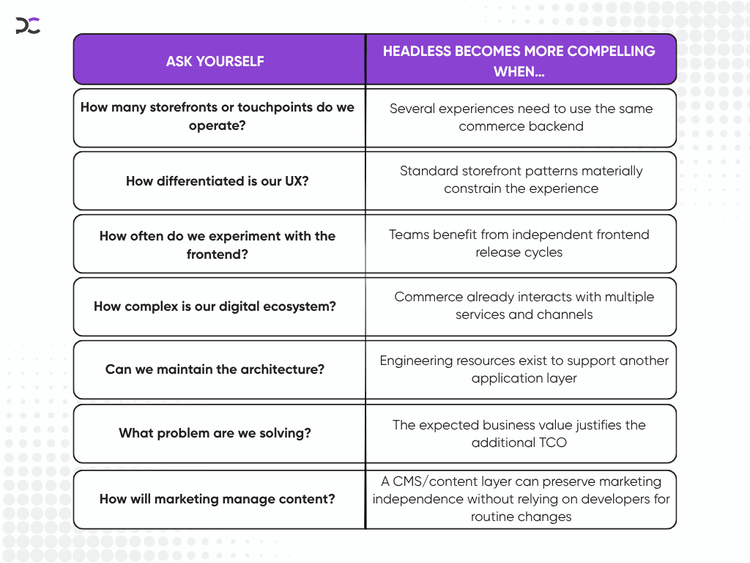
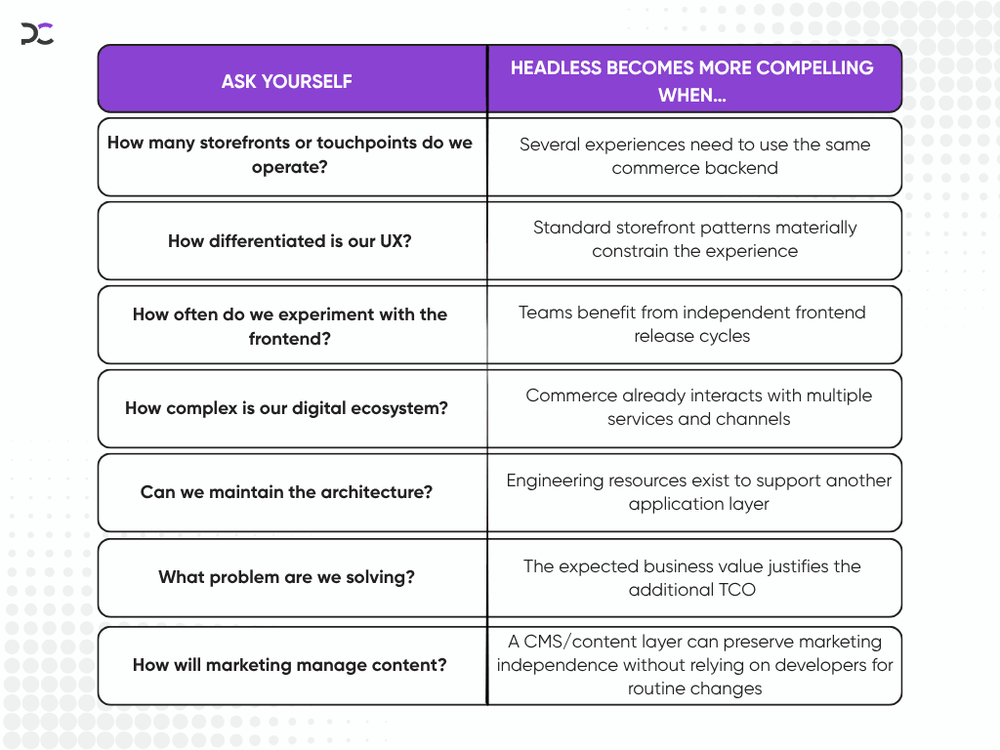
There is no architectural prize for running the most decoupled e-commerce stack.
For some Magento businesses, headless creates exactly the independence needed to support new markets, channels, experiences, and future growth. For others, the same flexibility becomes an expensive capability with limited practical use.
The decision should begin with the constraint you are trying to remove.
If you're evaluating a headless Magento migration, Polcode can help assess the current architecture, expected benefits, technical implications, and long-term cost before you commit to a particular approach.
FAQs About Headless Magento
Is Magento headless by default?
Magento supports API-driven architectures, but a Magento implementation does not become headless automatically. A separate frontend and the architecture connecting it with Magento need to be designed and implemented.
Does headless improve Magento performance?
It can. Headless enables modern frontend optimization and rendering strategies, but performance still depends on the frontend implementation, Magento backend, infrastructure, integrations, and third-party services.
Is PWA Studio required for headless Magento?
No. Headless Magento can use different frontend approaches and frameworks. The appropriate choice depends on the project's architecture, requirements, and development capabilities.
How long does a headless Magento build take?
There is no useful universal estimate. Scope depends heavily on storefront complexity, integrations, checkout requirements, content architecture, migration needs, and the amount of custom frontend functionality involved.
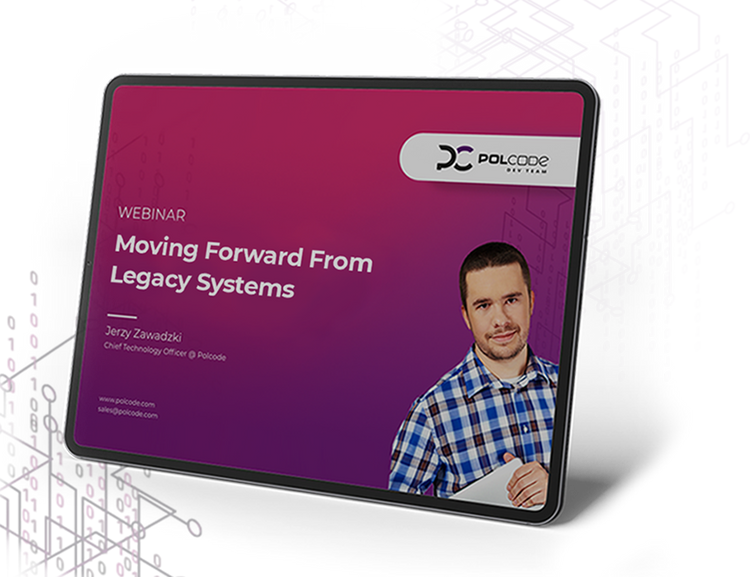
On-demand webinar: Moving Forward From Legacy Systems
We’ll walk you through how to think about an upgrade, refactor, or migration project to your codebase. By the end of this webinar, you’ll have a step-by-step plan to move away from the legacy system.
Latest Blog Posts
Magento vs Shopify for U.S. Mid-Market Brands: Which Platform Wins in 2026?
Sep 16, 2026 by Szymon Włodarski
Step-by-Step Guide: How to Choose the Right Magento Development Agency in the U.S.
Sep 11, 2026 by Michał Koziorowski
When Modern Frontends Matter: How React, Vue, and Angular Help Replace Slow, Hard-to-Maintain Interfaces
Sep 2, 2026 by Konrad Bolek
Before You Go Headless, Find Out What It Will Actually Solve
Show us where your storefront is holding you back
We’ll look at your customer experience, performance, content workflows, and plans for new markets or channels.
Compare the options and the costs
We’ll assess whether headless, targeted frontend improvements, or changes elsewhere in your Magento stack make the strongest business case.
Make your next move with a clear plan
If headless earns its place, we’ll help you define the architecture, scope, and investment before development begins.