


Legacy modernization rarely starts with technology. It starts when growing technical debt, operational constraints, or architectural limitations begin slowing the business. This guide explains the differences between refactoring, replatforming, and rebuilding, helping technology leaders understand when each approach delivers the greatest value and why successful modernization starts with evidence rather than assumptions.
Refactor, Replatform, or Rebuild? How to Choose the Right Legacy Modernization Path (part 1)
Legacy modernization rarely starts with technology. It starts when growing technical debt, operational constraints, or architectural limitations begin slowing the business. This guide explains the differences between refactoring, replatforming, and rebuilding, helping technology leaders understand when each approach delivers the greatest value and why successful modernization starts with evidence rather than assumptions.
TL;DR
Choosing the right legacy modernization strategy is a business decision, not just a technical one. Refactoring, replatforming, and rebuilding address different challenges, from reducing technical debt to removing infrastructure constraints or replacing architectures that no longer support business growth.
The most successful modernization initiatives begin with understanding what actually limits delivery and applying the right level of change to each part of the system, rather than defaulting to a single approach.
Executive Summary
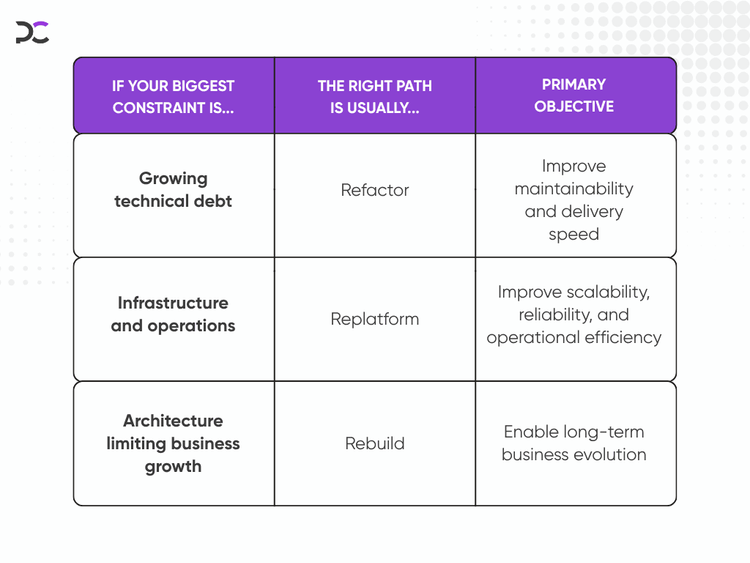
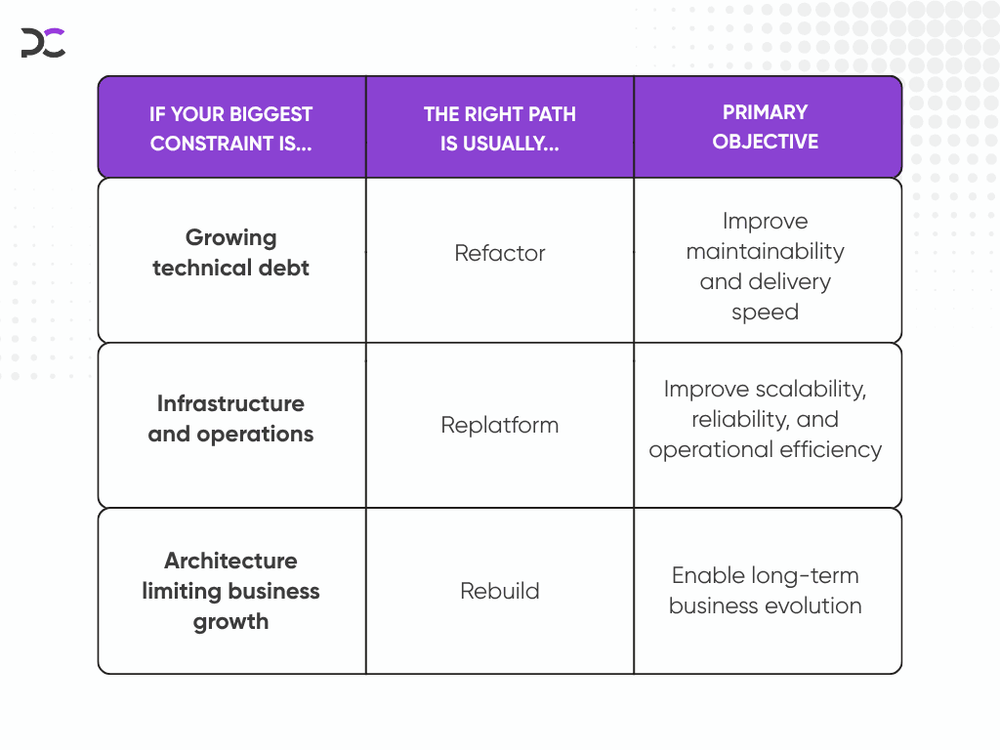
Refactor when the architecture is healthy but technical debt slows delivery.
Replatform when infrastructure, not the application, limits growth.
Rebuild when the architecture can no longer support future business goals.
Base modernization decisions on a software assessment, not technology preferences.
Many enterprise modernization programs combine multiple strategies to address different constraints across the same system.
When Legacy Systems Start Holding the Business Back
Legacy systems rarely become a problem overnight.
They evolve into one.
A release takes longer than expected. A new integration requires another workaround. Engineers become increasingly reluctant to modify existing code because every seemingly small change risks breaking something else. Infrastructure costs rise. Delivery slows. Eventually, technical debt stops being an engineering problem and starts affecting business performance.
That's usually the moment when leadership agrees that modernization can no longer wait.
Getting to that decision, however, is often the easy part.
The difficult question comes next:
Should we refactor, replatform, or rebuild?
Many organizations approach this as a technology decision. In reality, it's a business decision with long-term consequences for cost, delivery speed, operational risk, and future growth.
Choose the wrong path, and you may spend the next two years modernizing infrastructure while your biggest bottleneck remains untouched. Invest in a full rebuild when targeted refactoring would have solved the problem, and you risk delaying innovation while tying up engineering capacity. Keep refactoring an architecture that has already reached its limits, and technical debt will continue to grow behind every new feature.
After helping modernize more than 100 legacy systems across industries, including finance, eCommerce, automotive, legal services, and enterprise SaaS, we've learned one lesson that holds regardless of technology stack:
Successful modernization doesn't begin with choosing a solution. It begins with understanding the problem.
Only then can you decide how much of the system actually needs to change.
The Decision Nobody Wants to Get Wrong
When the Question Changes from "Should We?" to "How?"
Every modernization project reaches the same turning point.
For months, or even years, the organization has accepted slower releases, growing maintenance costs, and increasing technical debt as the price of keeping the business running.
Eventually, the conversation changes from
Should we modernize?
to
How should we modernize?
This is where many organizations make their first (expensive!) mistake.
Instead of assessing the system, they start evaluating solutions.
Teams that already believe cloud migration is the answer naturally recommend replatforming. Organizations frustrated with years of technical debt often assume rebuilding is inevitable. Others advocate for refactoring because it appears safer, cheaper, and easier to justify.
Every recommendation sounds reasonable.
None of them is a strategy.
A modernization strategy should emerge from evidence—not from technology preferences or organizational bias.
One of our projects for a Norwegian financial platform demonstrates why.
The client's objective seemed straightforward: migrate from dedicated on-premise servers to AWS to improve scalability and operational resilience.
Instead of starting with cloud migration, however, the project began with a software audit.
The assessment identified technical debt, highlighted architectural risks, compared migration costs, and recommended upgrading PHP and Laravel before moving workloads to AWS.
Only after reducing technical debt and preparing the application for cloud-native operations did cloud migration become the logical next step.
The lesson wasn't that AWS was the right answer.
The lesson was that the assessment determined the roadmap, not the other way around.
Executive Takeaway
Don't choose a modernization path before understanding what actually limits your business.
🔗 Application and Website Quality Audit: ISO 9001 and ISO 29119 Guide
Refactoring: Improve the System Without Reinventing It
Refactoring is often described as improving code without changing external behavior. Technically, that's correct. But from a leadership perspective, refactoring is a commitment to extending the life of an architecture that is fundamentally still worth investing in.
Refactoring works best when the application's core design remains sound, but accumulated technical debt has made development slower, riskier, or more expensive than it should be.
Typical signals include:
growing code duplication and inconsistent patterns,
slow delivery caused by fragile code,
recurring defects after seemingly minor changes,
increasing onboarding time for new developers,
outdated language versions or dependencies that limit further development.
Importantly, none of these automatically mean the architecture has failed.
We encountered exactly this situation while modernizing the platform of the Podlasie Opera and Philharmonic.
The website suffered from performance problems, inconsistent multilingual functionality, and recurring compatibility issues. At first glance, rebuilding the platform could have seemed like the obvious answer.
The assessment revealed something different.
The architecture itself remained perfectly capable of supporting the organization's needs. The real bottlenecks were outdated PHP versions, accumulated technical debt, inefficient translation mechanisms, and several implementation issues that had grown over time.
Instead of replacing the platform, we upgraded PHP, refactored critical components, optimized the translation layer, cleaned the database, and improved asset delivery.
The result was a faster, more stable platform, without the cost, disruption, or risk of rebuilding.
The lesson is simple.
If the architecture still supports the business, rebuilding is rarely the first answer.
Refactoring is usually the right choice when:
The architecture is still sound.
Technical debt slows delivery.
Business continuity is critical.
New functionality remains achievable without redesigning the entire platform.
🔗Refactor to Evolve: How Cleaning Up Code Reduces Tech Debt and Boosts Performance
Replatforming: Remove Operational Constraints Before They Slow the Business
Replatforming is often reduced to a cloud migration.
In practice, it's much more than that.
Its purpose isn't to change what the application does, but to improve how it runs, scales, and is operated. The business logic may remain largely unchanged, while the environment around it evolves to meet current operational demands.
Organizations typically choose this path when the application continues to deliver business value, but the infrastructure supporting it has become the primary constraint.
That might involve:
migrating from on-premises infrastructure to cloud environments,
adopting managed databases or container platforms,
modernizing deployment pipelines,
enhancing platform observability,
improving disaster recovery capabilities,
reducing operational overhead.
These changes don't fundamentally alter the product, but they can significantly improve its reliability, scalability, and maintainability.
One important misconception, however, is worth addressing.
Cloud migration is not a modernization strategy in itself.
Moving workloads from on-premises infrastructure to AWS, Azure, or Google Cloud doesn't automatically solve architectural problems. It simply provides a more modern environment for running the same application.
If the codebase remains difficult to maintain, the architecture limits future development, or technical debt continues to slow delivery, those challenges won't disappear after migration.
A project we delivered for Synega, a SaaS platform for remote accounting services, illustrates this well.
The client's objective seemed straightforward: migrate from dedicated servers to AWS.
Rather than treating cloud migration as the starting point, we began with a software audit.
The assessment evaluated the application's architecture, code quality, infrastructure, maintainability, and long-term operating costs. Based on those findings, the first recommendation wasn't to migrate workloads.
It was to upgrade PHP and Laravel, reduce technical debt, and prepare the platform for cloud-native operations.
Only then did cloud migration become the logical next step.
The result wasn't simply an application hosted in the cloud.
It was a platform that became easier to maintain, safer to operate, and better prepared for future growth.
The distinction matters.
Infrastructure modernization removes operational constraints.
It doesn't eliminate architectural debt.
Executive Takeaway
Replatform when infrastructure limits growth—not when architecture does.
🔗Modernizing Legacy Infrastructure for Cloud and Hybrid Operations
Rebuilding: Starting from What the Business Needs, Not What the Code Allows
Compared with refactoring or replatforming, rebuilding demands the highest level of investment, executive commitment, and organizational discipline. It often requires years of work, parallel environments, carefully planned migrations, comprehensive testing, and close collaboration between engineering and business teams.
Because of that, rebuilding is frequently seen as the riskiest option.
Ironically, there are situations where it's the least risky decision an organization can make.
There comes a point when the architecture itself becomes the limiting factor. New features take months instead of weeks. Integrations become increasingly fragile. Every release introduces unnecessary uncertainty. Engineering effort shifts away from creating new value and towards maintaining yesterday's decisions.
At that stage, continuing to invest in the existing platform may cost more than replacing it. Not immediately. But over the next five or ten years.
That's why the decision to rebuild should never be driven by engineering frustration alone. It should be driven by business capability.
Questions worth asking include:
Does the current architecture prevent strategic initiatives?
Can the platform realistically support the company's growth over the next five to ten years?
Is technical debt accumulating faster than it can be reduced?
Are engineering teams spending more time maintaining the system than developing new capabilities?
Would rebuilding reduce long-term complexity rather than simply introduce new technology?
If the answer to most of these questions is yes, rebuilding becomes a strategic investment.
It's equally important to recognize that successful rebuilds rarely happen as a "big bang."
One of the strongest examples from our modernization portfolio is Velocity Motoring.
Over five years, the platform evolved gradually from Symfony 1.0 to Symfony 5. Rather than replacing the legacy system in a single step, both environments coexisted while new functionality was introduced incrementally.
Modern tooling was added first.
Automated testing followed.
Core functionality was migrated in stages.
Only after the new platform had proven stable were legacy components retired.
Business operations continued throughout the entire modernization program.
The project demonstrates an important principle:
Successful rebuilding is usually a sequence of controlled decisions—not one large decision.
Executive Takeaway
Rebuild when your architecture prevents future growth—not simply because your technology is old.
One More Thing: Most Organizations Don't Choose Just One Path
Articles about legacy modernization often compare refactoring, replatforming, and rebuilding as though organizations must choose a single approach.
In practice, that's rarely how successful modernization works.
Enterprise platforms don't age uniformly.
One part of the system may only require refactoring. Infrastructure may benefit from cloud modernization, while another component has reached the point where rebuilding is the only sensible option.
The most effective modernization programs combine different strategies, applying each where it delivers the greatest business value.
That's exactly what happened during the modernization of Firm Prospects, a legal market intelligence platform.
Instead of treating the system as one monolithic problem, we modernized the areas that created the biggest constraints.
The project included:
redesigning the database model,
introducing a scalable search and analytics engine,
modernizing infrastructure,
improving reporting,
optimizing backend architecture.
Different constraints required different modernization strategies.
Together, they created a platform ready for long-term growth.
This is why experienced modernization teams rarely ask:
Which modernization strategy is best?
Instead, they ask:
Which strategy best solves this specific constraint?
The distinction may seem subtle, but it fundamentally changes how modernization programs are planned.
In Part 2, we'll look at what happens when organizations choose the wrong modernization path, the warning signs worth spotting early, and a practical framework that helps make the decision with confidence.
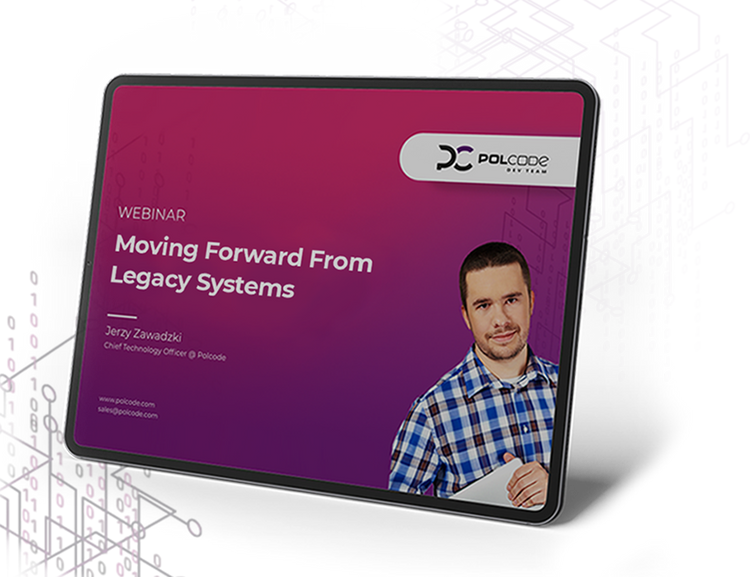
On-demand webinar: Moving Forward From Legacy Systems
We’ll walk you through how to think about an upgrade, refactor, or migration project to your codebase. By the end of this webinar, you’ll have a step-by-step plan to move away from the legacy system.
Latest Blog Posts
Step-by-Step Guide: How to Choose the Right Magento Development Agency in the U.S.
Sep 11, 2026 by Michał Koziorowski
When Modern Frontends Matter: How React, Vue, and Angular Help Replace Slow, Hard-to-Maintain Interfaces
Sep 2, 2026 by Konrad Bolek
Better Prompts Start With Better Context
Aug 25, 2026 by Michał Hossien
Plan Your Legacy Modernization with Confidence
Assess Your Current System
We analyze your architecture, technical debt, infrastructure, and operational risks to identify what is really slowing your business.
Define the Right Modernization Strategy
Based on the assessment, we recommend where refactoring, replatforming, rebuilding, or a combination of these approaches will create the most value.
Build a Practical Roadmap
Receive a prioritized modernization plan that minimizes risk, supports business continuity, and aligns technology investments with your long-term goals.