


TL;DR
Legacy infrastructure doesn't fail dramatically — it drains you slowly.
Rising maintenance costs, AI and analytics demands, tighter compliance requirements, and shrinking tolerance for downtime are quietly turning yesterday's technical decisions into today's business liabilities.
The good news is that modernization doesn't mean blowing everything up. Most enterprises are moving toward hybrid operating models, keeping sensitive or predictable workloads on private infrastructure while shifting others to the cloud, using incremental, risk-aware strategies built around workload suitability, not one-size-fits-all migration.
If your organization has already invested in CI/CD pipelines and automated testing, you're closer to cloud-ready than you think.
What you need now is a clear-eyed assessment of what you have, where the risks are, and how to move forward without trading one set of problems for another.
Modernizing Legacy Infrastructure for Cloud and Hybrid Operations
TL;DR
Legacy infrastructure doesn't fail dramatically — it drains you slowly.
Rising maintenance costs, AI and analytics demands, tighter compliance requirements, and shrinking tolerance for downtime are quietly turning yesterday's technical decisions into today's business liabilities.
The good news is that modernization doesn't mean blowing everything up. Most enterprises are moving toward hybrid operating models, keeping sensitive or predictable workloads on private infrastructure while shifting others to the cloud, using incremental, risk-aware strategies built around workload suitability, not one-size-fits-all migration.
If your organization has already invested in CI/CD pipelines and automated testing, you're closer to cloud-ready than you think.
What you need now is a clear-eyed assessment of what you have, where the risks are, and how to move forward without trading one set of problems for another.
If your organization has already invested in automated testing, regression coverage, and CI/CD pipelines for legacy systems, you've completed the hardest part of modernization: making change less risky.
The next question is whether your infrastructure can actually support what your business will need over the next five years.
For most enterprises operating on legacy systems, supporting those requirements increasingly requires legacy system modernization, architectural, and operational change.
Legacy Infrastructure Is a Competitive Liability
Legacy systems rarely fail suddenly. The problem is slower and more expensive: over time, maintaining and evolving these environments becomes operationally unsustainable. Infrastructure decisions made ten or fifteen years ago were built around predictable workloads, manual operations, and relatively static business processes. Modern enterprises look nothing like that.
Today's expectations include continuous availability, API-first integration, real-time analytics, and compute demands that can shift dramatically depending on AI workloads or business seasonality. Legacy operating models were never designed for this level of flexibility, and the gap between what they can do and what the business needs is widening every year.
This isn't a cloud-versus-on-premises debate. The real question is whether the current infrastructure model allows your organization to scale workloads efficiently, recover quickly from failures, integrate new services without months of coordination, and evolve architecture without excessive operational overhead. Organizations that can't do this are accumulating a competitive disadvantage that compounds quietly (until it doesn't).
Why the Pressure to Modernize Intensified
Three forces have made legacy software modernization a strategic priority rather than a long-term aspiration.
Resilience became non-negotiable.
Downtime tolerance has decreased significantly. Global customer bases and always-on digital channels mean that outages, which were once manageable maintenance events, now create direct financial and reputational damage. For many organizations, the strongest argument for cloud migration isn't AI adoption — it's operational resilience. High availability, automated failover, and faster recovery times are clearer business justifications than almost anything else.
AI workloads exposed infrastructure gaps.
Running AI doesn't automatically require public cloud infrastructure; many organizations do it successfully on private or hybrid environments. But AI and advanced analytics impose real pressure on scalable compute orchestration, storage performance, and data accessibility. “AI-ready architecture” typically means infrastructure that supports scalable compute allocation, API-driven integration, unified access to operational data, and observability across distributed workloads.
Rigid legacy systems make these capabilities significantly harder and more expensive to implement over time.
Infrastructure economics shifted.
Aging hardware refresh cycles, rising energy costs, GPU procurement timelines, and growing specialization requirements for infrastructure teams have changed the cost calculus. For some workloads, hyperscale cloud providers offer operational flexibility that would be prohibitively expensive to replicate internally. For others, particularly predictable long-term workloads, private infrastructure may still be more cost-efficient. This is why modern legacy-to-cloud migration strategies focus on workload placement rather than wholesale cloud adoption.
Not every workload benefits equally from cloud economics, which is why infrastructure modernization focuses on workload suitability rather than one-size-fits-all migration strategies.
Hybrid Is the Default, Not Full Migration
One of the most persistent misconceptions about cloud application migration is that it means abandoning on-premises infrastructure entirely. In practice, most enterprises are moving toward hybrid operating models, and for good reason.
Hybrid architecture allows organizations to retain sensitive workloads in private environments, meet regulatory and data sovereignty requirements, and maintain low-latency systems where needed, while still taking advantage of elastic scaling capabilities and managed services for workloads where those benefits are most valuable. For regulated industries in particular, this is often the only practical modernization path.
The goal is operational flexibility: the right workload in the right environment, with the ability to shift that balance as the business evolves.
Hybrid environments also introduce additional operational complexity, particularly around networking, observability, identity management, and governance. Successful hybrid strategies depend on strong operational standards and automation across environments, not simply distributing workloads between cloud and private infrastructure.
What Stops Companies From Migrating — And Why Those Barriers Are Surmountable
Most organizations know modernization is necessary. What holds them back is a set of legitimate concerns: downtime risk, data loss, compliance exposure, unpredictable costs, and internal skills gaps.
These concerns are real. But organizations that have already invested in testing automation and deployment discipline are significantly better positioned to address them than they realize.
Downtime risk is addressed through modern migration practices — blue-green deployments, canary releases, staged cutovers, and rollback automation. These approaches make migration far less binary than organizations expect.
Cost uncertainty is addressed through FinOps disciplines built into the migration from day one: rightsizing, cost visibility, reserved capacity planning, and engineering-finance accountability. Early cloud migrations often failed because teams treated the cloud as unlimited capacity. Modern cloud application modernization services are designed around cost transparency and predictable operational spend.
Skills gaps are addressed through modernization partnerships — not just for migration execution, but for building internal operational maturity. The goal is that your team can run what's been built, not just inherit it.
Choosing the Right Migration Strategy
Not every system should follow the same path. The "5 Rs" framework, Rehost, Replatform, Refactor, Rebuild, Replace, remains one of the most practical ways to evaluate cloud migration strategies across a portfolio of systems.
Rehost (lift-and-shift) moves workloads to cloud infrastructure with minimal architectural change. It's best suited for reducing hardware dependency, improving disaster recovery, or exiting aging data centers quickly. It delivers fast results but leaves architectural debt in place.
Replatform migrates systems while adopting selected managed services, managed databases, monitoring platforms, or container orchestration, without a full redesign. This improves operational efficiency meaningfully while limiting risk.
Refactor redesigns applications around cloud-native or distributed patterns. It's the most effective path for organizations seeking long-term scalability, faster feature delivery, and support for AI or analytics workloads, but it requires more investment and planning.
Rebuild and Replace are appropriate when technical debt makes continued maintenance economically impractical, or when a SaaS solution can replace custom software where differentiation is no longer strategic.
For most enterprises, modernization involves a combination of these strategies across different systems. The decision depends on each system's criticality, integration complexity, and long-term business value, which is exactly what a cloud-readiness assessment is designed to surface.
Data Migration: The Layer Most Projects Underestimate
Legacy systems often carry inconsistent schemas, hidden data quality issues, undocumented integration dependencies, and compliance constraints that only become visible during migration planning. Successful programs approach data migration incrementally and with continuous validation, never assuming data integrity, verifying at every stage, and automating validation wherever possible. Treating data migration as an afterthought is one of the most common reasons cloud migration projects run over budget and over time.
What a Cloud-Readiness Assessment Actually Covers
Modernization initiatives that begin without clear visibility into the current environment tend to discover problems at the worst possible time. A proper cloud-readiness assessment evaluates infrastructure dependencies, workload criticality, integration architecture, availability requirements, compliance constraints, security posture, and long-term operational costs. It identifies which systems are suitable for cloud migration, which are better suited for hybrid deployment, and which should remain on private infrastructure.
It's the foundation for a migration plan that reflects the actual complexity of your environment, not an idealized version of it.
What Real Results Look Like: Firm Prospects
Firm Prospects, a legal intelligence provider, faced scalability limitations and rising operational overhead from aging infrastructure that couldn't support the platform's growth trajectory.
Rather than pursuing a disruptive full rebuild, Polcode modernized the platform incrementally: migrating infrastructure components to the cloud, implementing Elasticsearch for faster data retrieval, and enabling business intelligence capabilities for reporting and analytics. The outcome was a 60% improvement in data processing speed, 99.9% system uptime, and a scalable foundation that the business could grow into, including future AI and analytics initiatives.
The case illustrates something important: cloud application modernization services don't have to mean starting over. Incremental modernization, done with the right sequencing and validation, almost always produces better outcomes than large-scale disruptive transformation.
How to Start: Low Risk, High Clarity
Before any infrastructure decision, organizations need clear answers: What do we actually have? Which systems create the most operational risk? Which workloads belong in cloud, hybrid, or private environments? What are the real cost and availability implications of each path?
A structured cloud-readiness workshop or proof-of-concept validates these assumptions before any large-scale commitment. It turns migration from a high-stakes leap into a series of deliberate, reversible steps, each one building confidence and operational capability for the next.
The most successful enterprises in 2026 aren't necessarily the ones with the largest public cloud footprint. They're the ones that built infrastructure capable of evolving safely, scaling predictably, and supporting whatever the business needs next. Cloud and hybrid architectures are central to that, not because cloud migration is a trend, but because operational rigidity increasingly isn't something businesses can afford to carry.
Ready to understand what modernization would actually look like for your environment?
Explore Polcode's legacy software modernization guide or read more about legacy modernization strategies.
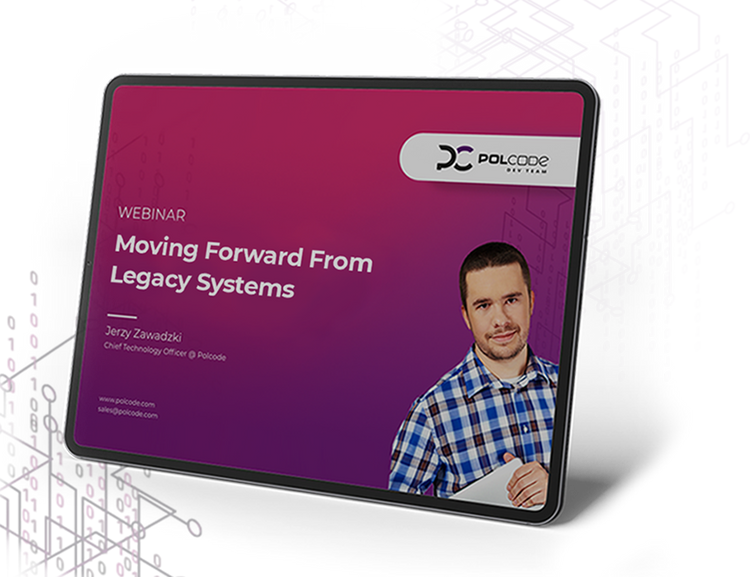
On-demand webinar: Moving Forward From Legacy Systems
We’ll walk you through how to think about an upgrade, refactor, or migration project to your codebase. By the end of this webinar, you’ll have a step-by-step plan to move away from the legacy system.
Latest Blog Posts
Plan Your Legacy Infrastructure Modernization with Confidence
Assess Your Current Environment
Identify infrastructure bottlenecks, operational risks, technical debt, and workload dependencies to understand what’s ready for modernization and what requires a different approach.
Define the Right Migration Strategy
Choose the best path for each system, rehost, replatform, refactor, or hybrid deployment, based on business priorities, scalability needs, compliance requirements, and long-term costs.
Modernize Incrementally and Reduce Risk
Validate decisions through workshops, proofs of concept, and phased migration plans that improve resilience, scalability, and cloud readiness without disrupting critical operations.