


Legacy modernization rarely starts with technology. It begins when technical debt, operational constraints, or architectural limitations start slowing the business. This guide explains the differences between refactoring, replatforming, and rebuilding, helping technology leaders determine which approach fits their systems, business goals, and long-term modernization strategy.
Refactor, Replatform, or Rebuild? How to Choose the Right Legacy Modernization Path (part 2)
Legacy modernization rarely starts with technology. It begins when technical debt, operational constraints, or architectural limitations start slowing the business. This guide explains the differences between refactoring, replatforming, and rebuilding, helping technology leaders determine which approach fits their systems, business goals, and long-term modernization strategy.
TL;DR
Choosing the right legacy modernization strategy is a business decision, not just a technical one. Refactoring, replatforming, and rebuilding solve different problems, and selecting the wrong approach can create years of unnecessary cost and complexity. Successful modernization starts with understanding whether your biggest constraint lies in the architecture, infrastructure, or the way the software has evolved over time.
Executive Summary
Refactor when the architecture is healthy but technical debt slows delivery.
Replatform when infrastructure, deployment, or operational constraints limit performance and scalability.
Rebuild when the existing architecture can no longer support future business goals.
Assess architecture, technical debt, infrastructure, and business capability before choosing a modernization strategy.
Many successful modernization programs combine refactoring, replatforming, and rebuilding across different parts of the same system.
New to this topic? Start with Part 1: Refactor, Replatform, or Rebuild? How to Choose the Right Legacy Modernization Strategy, where we explain the differences between each approach and the factors that should guide modernization decisions.
The Real Cost of Choosing the Wrong Path
Modernization costs are easy to estimate. The cost of choosing the wrong modernization strategy is much harder to measure and often significantly higher.
Organizations often compare modernization options based on implementation cost alone. In practice, the largest expense usually comes months, or even years, later, when the chosen approach no longer supports business objectives.
When Refactoring Delays the Inevitable
Refactoring creates tremendous value when the underlying architecture is healthy. When it isn't, every sprint becomes more expensive than the last.
Teams keep reducing technical debt while architectural debt continues to grow. New features require increasingly complex workarounds, onboarding slows down, and delivery becomes less predictable.
Eventually, the organization realizes it hasn't avoided a rebuild.
It has only postponed it, while investing significant engineering capacity along the way.
When Replatforming Becomes the Strategy Instead of the Step
Cloud migration is one of the most valuable modernization initiatives an organization can undertake. Unless it's expected to solve problems it was never designed to address.
Moving an application to AWS, Azure, or Google Cloud improves scalability, resilience, and operations. It does not automatically improve software architecture.
If business capabilities remain constrained after migration, the organization has simply moved technical debt to a different environment.
When Avoiding a Rebuild Becomes More Expensive Than Doing One
Every organization delays rebuilding for understandable reasons. It requires investment. Executive support. Engineering capacity. Business alignment.
But there comes a point where maintaining the existing architecture costs more than replacing it. Mostly, because innovation slows.
Competitors release new capabilities faster. Integrations become increasingly fragile.
Engineering talent spends its time maintaining yesterday's architecture instead of building tomorrow's products.
Sometimes the highest-risk decision is continuing exactly as you are.
A Practical Decision Framework
Modernization decisions should rely on evidence.
Before recommending any modernization strategy, we encourage leadership teams to evaluate five areas that consistently determine project success.
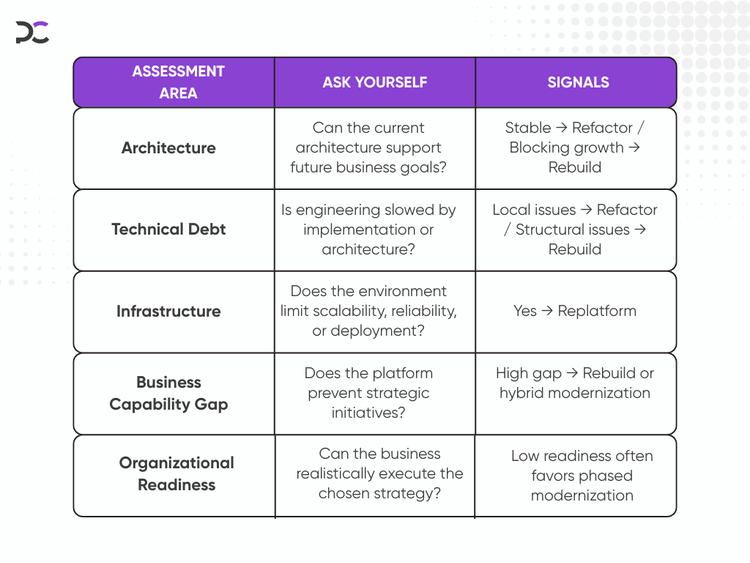
No single score determines the answer.
Instead, the assessment reveals where your biggest constraint actually lies.
Questions to Ask Before Choosing Refactoring
Is the architecture fundamentally still healthy?
Can new functionality be added without major redesign?
Are our biggest problems caused by implementation rather than architecture?
Will reducing technical debt noticeably improve delivery speed?
If the answer is yes to most of these questions, refactoring is likely the right starting point.
Questions to Ask Before Choosing Replatforming
Is infrastructure limiting performance or scalability?
Are deployment and operational processes slowing delivery?
Would cloud-native services significantly reduce operational overhead?
Does the application logic still support future business needs?
If so, replatforming may remove operational constraints without unnecessary disruption.
Questions to Ask Before Choosing a Rebuild
Does the current architecture actively block strategic initiatives?
Does technical debt continue growing despite ongoing refactoring?
Would maintaining the current platform cost more over the next five years than replacing it?
Is the organization prepared to support a multi-year transformation?
If the answer is consistently yes, rebuilding becomes a strategic investment rather than a technical preference.
Red Flags That You're Solving the Wrong Problem
Before committing to any modernization path, watch for these warning signs:
🚩 The solution was chosen before the assessment.
🚩 Cloud migration is expected to solve architectural problems.
🚩 Every system is treated as requiring the same modernization strategy.
🚩 Success is measured by technology delivered rather than business outcomes.
🚩 No one owns the modernization roadmap.
If any of these sound familiar, it's worth pausing before making a major investment.
Conclusion
Organizations often ask whether refactoring, replatforming, or rebuilding is the best modernization strategy.
The better question is:
What problem are we actually trying to solve?
The answer rarely points to a single approach.
Successful modernization is about choosing the right level of change for each constraint the organization faces and executing that change in a way the business can sustain.
Sometimes that means extending the life of an existing platform through refactoring. Sometimes it means removing operational bottlenecks through replatforming. Sometimes it means rebuilding critical capabilities from the ground up.
More often than not, it means combining all three.
The organizations that modernize successfully aren't the ones that choose the most ambitious strategy.
They're the ones who choose the strategy they can understand, govern, fund, and execute, supported by evidence rather than assumptions.
If your legacy platform is beginning to slow delivery, increase operational risk, or limit future growth, the first step isn't deciding whether to refactor, replatform, or rebuild.
It's understanding where your biggest constraint really is.
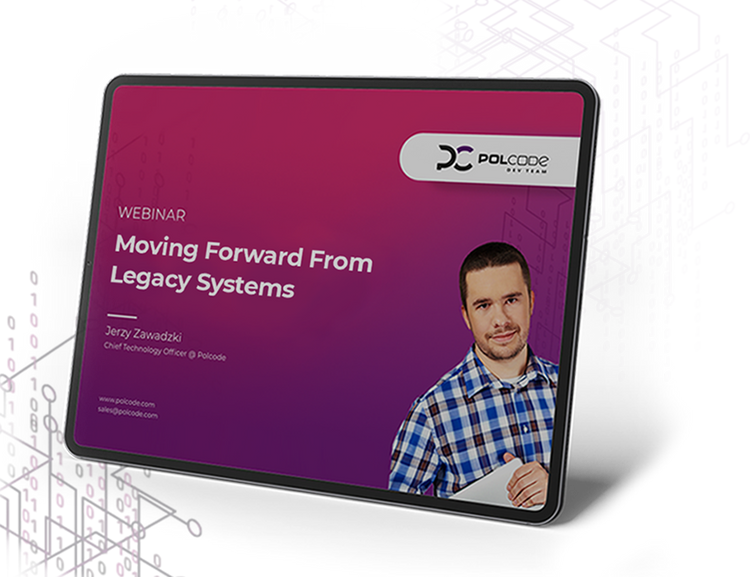
On-demand webinar: Moving Forward From Legacy Systems
We’ll walk you through how to think about an upgrade, refactor, or migration project to your codebase. By the end of this webinar, you’ll have a step-by-step plan to move away from the legacy system.
Latest Blog Posts
Step-by-Step Guide: How to Choose the Right Magento Development Agency in the U.S.
Sep 11, 2026 by Michał Koziorowski
When Modern Frontends Matter: How React, Vue, and Angular Help Replace Slow, Hard-to-Maintain Interfaces
Sep 2, 2026 by Konrad Bolek
Better Prompts Start With Better Context
Aug 25, 2026 by Michał Hossien
Plan Your Legacy Modernization with Confidence
Assess Your Current System
We analyze your architecture, technical debt, infrastructure, and operational risks to identify what is really slowing your business.
Define the Right Modernization Strategy
Based on the assessment, we recommend where refactoring, replatforming, rebuilding, or a combination of these approaches will create the most value.
Build a Practical Roadmap
Receive a prioritized modernization plan that minimizes risk, supports business continuity, and aligns technology investments with your long-term goals.