

TL;DR
Benx needed more than a standard e-commerce store.
As a leading UK supplier of façade and insulation systems, their sales process relied heavily on technical expertise, manual calculations, and customer consultations.
We built a Magento 2 B2B platform integrated with Sage ERP, complete with a custom EWI calculator and configurable product logic that allows contractors to estimate materials, access accurate pricing and stock information, and place orders online. The result is a scalable digital sales channel that preserves the complexity of Benx's expertise while improving operational efficiency.
Building a Magento B2B E-Commerce Platform with Sage ERP Integration
TL;DR
Benx needed more than a standard e-commerce store.
As a leading UK supplier of façade and insulation systems, their sales process relied heavily on technical expertise, manual calculations, and customer consultations.
We built a Magento 2 B2B platform integrated with Sage ERP, complete with a custom EWI calculator and configurable product logic that allows contractors to estimate materials, access accurate pricing and stock information, and place orders online. The result is a scalable digital sales channel that preserves the complexity of Benx's expertise while improving operational efficiency.
The Challenge: Scaling Construction Expertise
In many B2B environments, the most valuable assets aren’t the product catalogue itself. It’s the knowledge required to select, configure, and apply those products correctly.
That knowledge often lives with experienced employees. It gets shared through conversations, spreadsheets, manual calculations, and years of industry expertise. The process works well until the business wants to scale.
This was the challenge we were brought in to solve at Benx.
The Project: Magento B2B E-Commerce for a UK Construction Supplier
Benx has supplied façade and insulation systems to large-scale construction projects across the UK since 2002. Their client relationships are built on deep technical expertise; the kind that doesn't translate easily into a product listing and an "add to cart" button.
When Benx decided to launch their first e-commerce platform, the goal was to make what they do digitally accessible without losing the accuracy and complexity that makes their offer valuable.
We built the platform on Magento 2, integrated it with Benx's Sage ERP system, and developed a custom product configurator and an EWI (External Wall Insulation) calculator from the ground up.
The result is a digital sales channel that allows professional installers and contractors to access product information, estimate material requirements, and place orders online while remaining aligned with Benx's existing operational processes.
What Is a Magento B2B E-Commerce Platform with ERP Integration?
A Magento B2B e-commerce platform with ERP integration connects online sales with backend systems like Sage ERP, allowing product data, pricing, stock levels, and orders to move automatically between systems.
For B2B organisations, this eliminates duplicate data entry, improves operational visibility, and ensures customers see accurate information throughout the purchasing process.
The technology itself is important, but successful implementations depend just as much on understanding how the business operates and where critical information originates.
B2B E-Commerce Discovery Phase: Why It Matters Before Development
Before development started, we ran a series of discovery workshops with the Benx team to map out exactly what needed to be built and why.
This covered:
core business goals for the first phase,
integration requirements between Magento 2 and Sage ERP,
user journeys for two distinct target groups (architects and installers),
product catalogue structure,
rules for configurable items.
That last point matters more than it might seem.
In construction, a product isn't just a stock-keeping unit (SKU). It is part of a larger system, and the correct configuration depends on multiple variables that influence each other in ways that are not always obvious.
Another important part of the discovery phase involved understanding the data itself. Before any migration could be planned, we needed to identify which products would be available online, how their attributes should be structured, and how they should be organised within the catalogue.
Particular attention was given to customer groups and pricing rules. Like many B2B suppliers, Benx operates with different pricing structures for different customer segments, making discount-group mapping a critical part of the platform architecture.
Equally important was determining how the platform would access ERP data. Rather than introducing entirely new integration mechanisms, we built on data access methods that had already been validated within Benx's existing systems. This reduced implementation risk and allowed us to focus on business logic rather than infrastructure uncertainty.
Getting these decisions right before development began prevented significant rework later in the project.
The ERP Integration: Making Real-Time Data the Default
The Magento–Sage ERP integration forms the operational backbone of the platform.
Product information, stock levels, customer pricing, and orders now flow automatically between systems. Information that previously had to be entered multiple times now exists in a single source of truth.
For a business operating across four regional warehouses, this has a direct operational impact. Customers can see stock availability across locations, while orders are routed through existing fulfilment processes without additional manual handling.
Although this sounds straightforward, several architectural decisions had to be made before implementation could begin.
One of the most important was determining how frequently different types of data should be synchronised.
A fully real-time integration often sounds attractive in theory, but not every type of data benefits equally from real-time updates. Product pricing, for example, changes relatively infrequently and does not justify the infrastructure overhead of constant synchronisation. Stock availability is a different matter. If a customer sees inventory that is no longer available, it can create delays, operational friction, and lost trust.
For that reason, pricing updates were synchronised on a scheduled basis, while stock data and order processing operated on significantly shorter update cycles. This approach balanced performance, reliability, and operational requirements without introducing unnecessary complexity.
Another key architectural decision involved how warehouse data would be represented within Magento. Each Sage warehouse was mapped to a separate inventory source, allowing the platform to support location-based stock visibility and click-and-collect functionality. Customers can now see which branch has stock available and select the most convenient collection point during the purchasing process.
Like most ERP integrations, the project also required careful handling of exceptions and edge cases. Some products are manufactured to order rather than held in stock, meaning availability rules differ from standard inventory items. The platform needed to communicate those differences clearly without disrupting the purchasing journey.
These are the kinds of decisions that rarely appear in a project scope document but have a significant impact on how successfully a B2B platform operates after launch.
The EWI Calculator: Encoding Construction Logic Into a Guided Interface
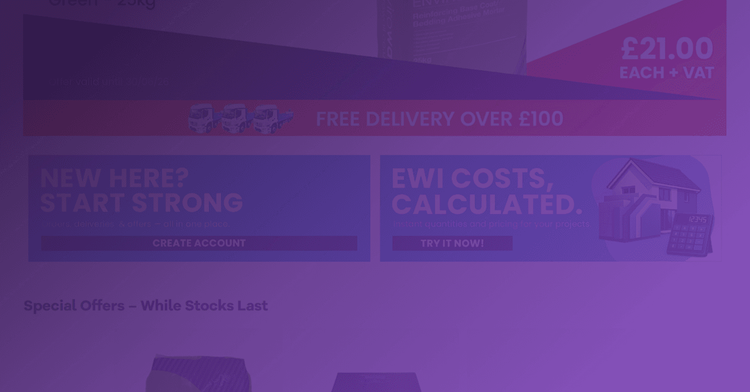
The EWI Calculator was the most technically complex part of the project and the feature that most directly replaces processes that previously happened through phone calls, emails, and manual calculations.
The calculator takes project-specific information such as building type, façade dimensions, insulation requirements, substrate type, and system configuration, then translates those inputs into a recommended list of materials.
The same wall area can produce entirely different outputs depending on how those variables combine. A semi-detached property with multiple openings requires a different combination of boards, adhesives, and finishing products than a solid wall of the same size.
Capturing those dependencies accurately while keeping the interface simple enough for installers was one of the project's biggest challenges.
The solution we built has three layers working together:
dynamic integration with the Magento product database so outputs reflect live catalogue data,
configurable business logic that Benx admins can update without developer involvement,
a step-by-step interface that presents complexity progressively rather than all at once.
The most important architectural decision was making the calculator's business logic fully configurable rather than hardcoding it into the application.
Construction systems evolve constantly. Manufacturers introduce new products, update specifications, and adjust recommended configurations. Hardcoded rules would have required developer involvement every time the business needed to make a change.
Instead, the calculator was built around a configurable rules engine managed through the administration panel. Questions, answer options, dependencies, and calculation logic are all stored in a configurable data model that can be updated without modifying application code.
This allows Benx to introduce new product ranges, adjust workflows, and update system recommendations independently, reducing long-term maintenance costs while increasing operational flexibility.
Making the Logic Editable and Why That Matters
One of the biggest design discussions during the project was not how the calculator should perform calculations, but who would be responsible for maintaining it after launch.
Building the logic directly into the codebase would have been faster initially. However, every future change to a material specification, system recommendation, or product range would have required a development request.
In an industry where specifications evolve regularly, that approach quickly becomes a bottleneck.
By moving the logic into a configurable layer managed through the admin interface, we created a system that can evolve alongside the business. Benx can update product dependencies, introduce new decision paths, and modify calculator behaviour without waiting for a deployment cycle.
This was a deliberate architectural decision designed to maximise long-term business autonomy rather than short-term development convenience.
A Broader Note on Digitising Complex B2B Sales
The Benx project is a useful reference point for any business where sales depend on expertise, interpretation, and manual calculations.
The challenge in these environments is structuring the logic behind decisions in a way that can be applied consistently, and then building a system that carries that logic reliably, at scale, without requiring an expert in the room every time.
As David Meddings, IT Manager at Benx, put it: "They didn't just build to specification — they took the time to understand our workflows."
Magento's flexibility as a B2B e-commerce platform, combined with ERP integration and custom development, makes this type of implementation achievable. But the platform is only part of it. The work happens in understanding how the business operates and translating that knowledge into software that customers can use confidently.
That's what we did with Benx. Read the full Magento B2B e-commerce case study.
On-demand webinar: Moving Forward From Legacy Systems
We’ll walk you through how to think about an upgrade, refactor, or migration project to your codebase. By the end of this webinar, you’ll have a step-by-step plan to move away from the legacy system.
Latest Blog Posts
Step-by-Step Guide: How to Choose the Right Magento Development Agency in the U.S.
Sep 11, 2026 by Michał Koziorowski
When Modern Frontends Matter: How React, Vue, and Angular Help Replace Slow, Hard-to-Maintain Interfaces
Sep 2, 2026 by Konrad Bolek
Better Prompts Start With Better Context
Aug 25, 2026 by Michał Hossien
Planning a Complex B2B E-Commerce Platform?
Book a discovery workshop
Let's identify your business requirements and technical challenges.
Validate your integrations
Ensure your ERP, inventory, and pricing data work seamlessly together.
Build with confidence
Launch a scalable B2B platform designed around your business processes.