


TL;DR
Traditional IT outsourcing was built for short-term project delivery, but modern software requires long-term ownership, continuous evolution, and deep system knowledge.
Co-sourcing is emerging as a more sustainable alternative because it embeds external engineers directly into internal teams, creating shared accountability, preserving institutional knowledge, and reducing the long-term costs of technical debt, vendor churn, and fragmented delivery.
For complex initiatives such as legacy modernization and cloud migration, co-sourcing offers greater continuity, stronger governance, and a lower total cost of ownership than transactional outsourcing models.
From Outsourcing to Co-Sourcing: Evolving IT Partnership Models
TL;DR
Traditional IT outsourcing was built for short-term project delivery, but modern software requires long-term ownership, continuous evolution, and deep system knowledge.
Co-sourcing is emerging as a more sustainable alternative because it embeds external engineers directly into internal teams, creating shared accountability, preserving institutional knowledge, and reducing the long-term costs of technical debt, vendor churn, and fragmented delivery.
For complex initiatives such as legacy modernization and cloud migration, co-sourcing offers greater continuity, stronger governance, and a lower total cost of ownership than transactional outsourcing models.
Introduction: Why Outsourcing Models Are Being Rewritten
The original promise of IT outsourcing was straightforward: find capable developers at a lower cost, hand over a scope of work, and receive finished software in return. For a certain era of technology, when software was built in discrete projects, shipped, and largely left alone, this model worked well enough.
That era is over.
Today, software is not a deliverable. It is a living system that teams build, maintain, evolve, and defend against entropy for years at a time. Legacy platforms accumulate technical debt faster than vendors can clear it. Cloud migrations span multiple years and require sustained domain knowledge. Product teams run continuous delivery cycles, not quarterly releases. And the cost of knowledge loss, when a vendor relationship ends, and institutional understanding walks out the door with the contract, has become painfully visible to anyone who has lived through it.
The outsourcing model was not designed for any of this. It was designed for discrete transactions, not ongoing partnerships. That mismatch is now driving a shift toward something more structurally honest: co-sourcing.
What Traditional IT Outsourcing Gets Wrong
Let's be direct about something the industry tends to soften: traditional outsourcing often creates more problems than it solves, just on a delayed timeline.
The core flaw is transactional delivery. A vendor receives requirements, produces output, collects payment, and moves on. Accountability ends at the handover point. What happens next, the integration bugs, the undocumented decisions, the architectural choices that made sense at the time but now constrain the entire platform, becomes the internal team's problem.
Knowledge silos are the predictable result. Vendors optimize for completing tickets, not for understanding your domain. When engagement ends, or personnel rotate, and in offshore models, they rotate often, the accumulated context disappears. The next team starts from scratch. The one after that does too.
Then there's technical debt. Short-term delivery pressure, combined with limited vendor accountability for long-term consequences, reliably produces codebases that work on demo day and create compounding maintenance costs for years afterward. Deloitte’s 2026 Global Technology Leadership Study estimates that technical debt accounts for 21% to 40% of an organization’s IT spending. Outsourcing structures, by design, do not create incentives to prevent this.
None of this means outsourcing is always wrong. For isolated, well-scoped projects with limited long-term dependencies, a transactional model can be entirely appropriate. The problem is that most modern software work does not fit that description.
What Is Co-Sourcing and How Is It Different?
Co-sourcing is not a rebranded version of outsourcing. It is a fundamentally different operating model built on shared accountability rather than divided responsibility.
Co-sourcing means an external engineering team is embedded inside your delivery structure, participating in planning, architecture decisions, code review, and retrospectives, rather than operating as a separate unit that receives specifications and returns completed work. The external team does not just share your workload but also shares ownership of the outcome.
This distinguishes co-sourcing from two models it is often confused with.
Staff augmentation strengthens an existing team by adding engineers who contribute their skills, experience, and technical perspective within the client’s established delivery structure. Co-sourcing extends beyond additional capacity. The external team participates more deeply in planning, architectural decision-making, delivery governance, and long-term platform ownership. Many of these differences become most visible in day-to-day delivery quality, communication, and long-term project stability.
Fully managed delivery sits at the opposite end of the spectrum. The vendor owns the process entirely, and the client sees results, not methods. Co-sourcing sits between these poles: shared governance, shared knowledge, and shared standards.
The distinction matters operationally. In a co-sourced model, external engineers attend your standups. They are named owners of specific platform areas. They flag architectural risks, not just task completion. And when the engagement eventually changes form (because all partnerships do), the knowledge they built does not leave with them. It has been embedded in your codebase, your documentation, and your internal team.
Why Co-Sourcing Is Gaining Traction in 2026
Several forces have converged to make co-sourcing the natural evolution of the vendor relationship for engineering teams.
The shift from project to product is the most fundamental. Most technology organizations have moved away from discrete build cycles toward continuous product development. Features ship weekly, not quarterly. Infrastructure evolves constantly. There is no clean endpoint after which a vendor can hand over the keys and leave. Sustained delivery requires sustained partnership.
Legacy modernization has become a board-level priority for a significant share of mid-market and enterprise companies. These are not six-month engagements. Migrating a legacy PHP monolith to a modern cloud-native architecture, or incrementally refactoring a platform built on fifteen years of accumulated decisions, requires teams that develop genuine fluency in the system and the patience to work within it responsibly. Custom web application development services and application modernization services delivered through a co-sourced model preserve institutional knowledge through that process in ways that outsourcing simply cannot.
Tech debt management is the third driver. Organizations have begun to recognize technical debt not as a technical inconvenience but as a financial liability. Managing it proactively requires teams that have enough skin in the game to care about the long-term codebase quality.
Co-Sourcing and Legacy Software Modernization
Legacy systems are where traditional outsourcing models most visibly break down and where co-sourcing delivers its clearest operational advantage.
The failure mode is predictable. A company brings in an external team to modernize a legacy platform. The team works from specifications and documentation, neither of which fully captures how the system actually behaves in production. Undocumented edge cases accumulate. Architectural assumptions from the original build are misread. Delivery timelines slip. The client faces a difficult choice: extend an already-strained vendor relationship or accept a product that requires immediate remediation.
Big-bang rewrites amplify this risk. They require the external team to develop a complete system understanding before writing a line of new code and then to maintain that understanding across months of parallel development. Most outsourcing arrangements are structurally unsuitable for this. There is not enough continuity, not enough shared context, not enough joint accountability.
Co-sourced teams approach legacy modernization differently because they are embedded long enough to develop genuine system fluency. They understand why certain decisions were made. They can read the code's archaeology, the older patterns, the quick fixes, the compromises that made sense in 2014, and make informed choices about what to preserve, what to refactor, and what to replace. This is the foundation of responsible legacy system modernization.
Specifically for cloud application migration, the embedded model also ensures that infrastructure decisions are made with full awareness of the business context. A cloud migration that ignores the operational realities of the team that will run the new infrastructure is not a success, regardless of what the architecture diagram looks like.
Where Co-Sourcing Fails (and Why)
Co-sourcing is not a default improvement over outsourcing. It fails when the conditions for shared ownership do not exist.
Lack of internal product ownership is the most common failure mode. Co-sourcing requires a capable internal counterpart, a product owner, an engineering lead, or an architect, who can participate meaningfully in technical decisions. Without that, the external team defaults to filling a vacuum rather than sharing accountability. The result looks like outsourcing with extra process overhead.
Treating co-sourcing like cheaper staffing is equally damaging. Organizations that approach it as staff augmentation at scale, adding headcount to hit velocity targets without investing in the relationship, miss the model's core value. The point of co-sourcing is not throughput. It is shared ownership and accumulated knowledge. If the engagement is evaluated purely on tickets closed, it will be managed accordingly. Many of these misconceptions stem from broader team augmentation myths that conflate capacity with capability.
Absence of a shared roadmap or architectural authority creates drift. External teams making isolated technical decisions, without visibility into the product direction or participation in architecture forums, will make locally reasonable choices that create globally expensive problems. This is a process failure, not a talent failure.
Poor onboarding and documentation compound every other risk. Co-sourcing requires that external engineers can reach meaningful productivity quickly and that knowledge is codified rather than siloed. Teams that cannot onboard partners effectively, because the codebase is undocumented, the environment is brittle, or the culture is unwelcoming, will not benefit from co-sourcing regardless of the partner's capabilities.
Acknowledging these failure modes is not a caveat. It is a requirement for setting up the model to succeed.
Why Nearshore Teams in Poland Fit the Co-Sourcing Model
The choice of where a co-sourced team is based is not incidental. It shapes everything from daily collaboration quality to long-term team stability.
Poland has emerged as one of Europe's most established nearshore engineering locations, not as a cheaper alternative to Western European or US development, but as a structurally credible partner for sustained technical work.
On the operational side, Polish engineering teams work in time zones that align directly with both Central European and UK business hours, and with substantial overlap for US East Coast teams. This is not a marginal advantage. Daily synchronization, the standups, the design discussions, and the architecture calls are qualitatively different when teams are working at the same time rather than relaying messages across a twelve-hour gap.
Poland's technical depth is broad and deep. Polish developers are well-represented in backend and full-stack development across PHP, Python, and modern JavaScript frameworks like Vue.js. The talent pool spans cloud-native development and legacy platform expertise, a combination that is particularly valuable for organizations managing modernization programs alongside ongoing product delivery. For teams looking for a custom PHP application development company or Python web application development services, this depth is practically useful, not just a line on a capability slide.
Long-term team stability is the structural advantage that nearshore models tend to underestimate. Offshore outsourcing markets, particularly in regions with high talent competition, see significant personnel turnover. The co-sourced model depends on relationship continuity, on engineers who know the codebase, understand the domain, and have built working relationships with internal counterparts. Nearshore Polish teams have demonstrated significantly higher retention than comparable offshore arrangements, which directly protects the knowledge investment that co-sourcing is built to create.
Cost, Control, and Accountability: Co-Sourcing vs Outsourcing
Cost comparisons between co-sourcing and outsourcing are frequently misleading because they measure the wrong things. This misalignment is rooted in how engineering work is priced, particularly in hourly-based models.
Outsourcing appears cheaper on a rate-per-hour basis. It often is, at the point of contract signature. What the comparison omits is the accumulating cost of knowledge loss, vendor churn, technical debt, and re-work that transactional models generate over time. A platform rebuilt three times because three successive vendors lacked system context is not a cost-effective outcome, regardless of what each contract costs.
Co-sourcing offers a different cost structure: higher engagement investment, lower total cost of ownership. When external engineers function as genuine team members, with continuity, accountability, and shared stakes in the system's quality, the compounding costs of transactional delivery do not accumulate. Velocity is more predictable. Rework is less frequent. Knowledge is retained. For organizations navigating budget pressure alongside delivery commitments, this trade-off deserves careful analysis. The economics of surviving a downturn with an IT team extension look quite different from the economics of short-term outsourcing when you account for the total cost of ownership.
Control is the other dimension where co-sourcing offers a counterintuitive advantage. Fully outsourced delivery often reduces internal visibility into how decisions are being made because the process happens elsewhere. In a co-sourced model, internal teams are embedded in every significant technical decision. Governance is explicit, not assumed. That transparency is itself a form of risk reduction.
How to Decide If Co-Sourcing Is Right for Your Organization
Co-sourcing is not universally appropriate. Before committing to the model, consider these dimensions honestly.
Team maturity. Do you have internal engineering leadership capable of participating in architecture decisions and providing meaningful direction to an external team? Co-sourcing without an internal counterpart is outsourcing with more process vocabulary.
Product lifecycle stage. Co-sourcing is most valuable for products in sustained development: platforms being modernized, SaaS products scaling, and systems migrating to cloud infrastructure. It is less relevant for isolated greenfield projects with a clear endpoint and limited downstream maintenance.
Technical complexity. The greater the system complexity, legacy dependencies, multi-platform integrations, and accumulated technical debt, the more valuable sustained team knowledge becomes. High-complexity environments reward the continuity that co-sourcing provides and penalize the knowledge loss that outsourcing creates.
Internal leadership readiness. Does your organization have the internal capacity to onboard, integrate, and collaborate with an external team at a peer level? This means documentation, defined processes, and a culture that treats external engineers as team members rather than service providers.
If you can answer yes to most of these, the co-sourcing model is worth serious evaluation. If you cannot, the more honest starting point is investing in the internal foundations that would make it work, and considering what form of team extension might be appropriate in the interim. For a deeper look at how to evaluate your options, choosing the right software development partner involves more than comparing rates; it means assessing cultural fit, governance model, and long-term alignment.
Final Take: Co-Sourcing Is a Commitment, Not a Shortcut
The appeal of co-sourcing is real. Long-term partnerships that share knowledge, architectural accountability, and genuine team continuity do outperform transactional outsourcing for the kind of sustained, complex software work that defines most modern engineering organizations.
But that outcome requires something outsourcing does not: mutual investment. Co-sourcing is not a procurement decision. It is a working relationship, one that requires internal leadership readiness, clear governance, and the patience to build something that compounds in value over time rather than delivering a finished artifact on a fixed date.
The organizations that benefit most from co-sourcing are the ones that approach it as a partnership question, not a vendor selection question. They are not asking who can do this work cheapest. They are asking who can become a genuine part of how we build.
If that is the question your organization is ready to ask, it is worth having a specific conversation about how the model would apply to your platform, your team, and your current challenges.
Talk to Polcode about your engineering partnership options →
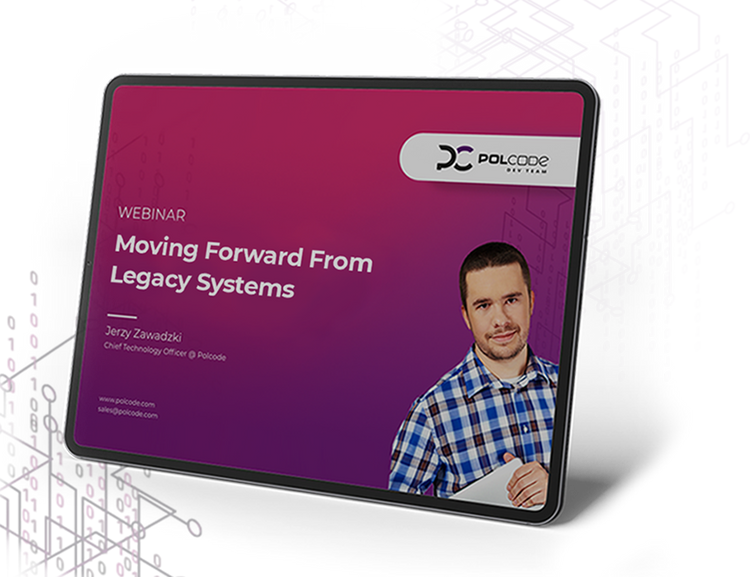
On-demand webinar: Moving Forward From Legacy Systems
We’ll walk you through how to think about an upgrade, refactor, or migration project to your codebase. By the end of this webinar, you’ll have a step-by-step plan to move away from the legacy system.
Latest Blog Posts
Modernizing Legacy Systems Without Creating Operational Risk
Aug 12, 2026 by Jerzy Zawadzki
Refactor, Replatform, or Rebuild? How to Choose the Right Legacy Modernization Path (part 2)
Jul 29, 2026 by Sebastian Stelmach
Refactor, Replatform, or Rebuild? How to Choose the Right Legacy Modernization Path (part 1)
Jul 28, 2026 by Sebastian Stelmach
Build a Stronger Engineering Partnership
Assess Your Delivery Challenges
Identify where traditional outsourcing creates friction: knowledge loss, technical debt, delivery instability, or lack of long-term ownership.
Define the Right Co-Sourcing Model
Work with experienced engineering partners to design a collaboration model that fits your product lifecycle, technical complexity, and internal team structure.
Scale with Embedded Engineering Teams
Integrate dedicated engineers into your workflows, architecture discussions, and delivery processes to build sustainable, long-term software capability.