


Legacy systems don’t just slow you down—they also shut you off. One of the biggest challenges with older software is how hard it is to connect with modern platforms. APIs don’t match, data gets stuck, and every integration turns into a painful workaround.
In this post, we’ll explore how legacy systems create integration bottlenecks and how modernization helps your tools work together (instead of against each other).
Breaking Down Silos: How to Make Legacy Systems Talk to Modern Tools Through APIs
Legacy systems don’t just slow you down—they also shut you off. One of the biggest challenges with older software is how hard it is to connect with modern platforms. APIs don’t match, data gets stuck, and every integration turns into a painful workaround.
In this post, we’ll explore how legacy systems create integration bottlenecks and how modernization helps your tools work together (instead of against each other).
Why Integration Still Fails (and What It Costs You)
As explained in Chapter 7 of our ebook "Legacy Software Modernization – a Guide for Enterprises", poor integration capabilities limit everything from your customer experience to your internal efficiency.
Incompatible or undocumented APIs
Legacy systems lack real-time data exchange capabilities
Manual processes are needed to move data
No support for modern data standards (JSON, REST, GraphQL)
Integration efforts often require expensive, brittle custom code
"Legacy software builds walls. Modern APIs build bridges."
Disconnected systems mean disconnected experiences for both users and teams.
The Business Risks of Disconnected Systems
Delayed access to key business data
Limited automation → reduced productivity
Poor customer experience due to system lag or data inaccuracy
Competitive disadvantage—slower time-to-market
Data silos reduce decision-making agility
Related: Refactor to Evolve: How Cleaning Up Code Reduces Tech Debt and Boosts Performance
Integration is a Growth Strategy—Not Just an IT Fix
Connected systems drive:
Smarter analytics
Real-time workflows
Streamlined user experiences
Automation readiness (AI, RPA, etc.)
Modernizing legacy systems through APIs doesn’t require a full rewrite. Smart layering with APIs, audits, and transformation logic can deliver agility and value fast.
Stop Fighting Your Tech Stack
What Makes Legacy Systems So Hard to Integrate?
Chapter 8 of the ebook breaks this down:
Built without APIs, or with outdated SOAP/XML endpoints
Custom code that is hard to audit or extend
Tight coupling between data and logic (no abstraction)
No support for REST, GraphQL, or webhooks
It’s not just frustrating. It slows your growth. Your competitors who have flexible, modern systems can integrate new tools faster and scale faster.
Learn more in Data Migration from Legacy Systems – How to Do It Effectively
Modern Integration, Step-by-Step: Our Proven Process
System and API audit
Identify gaps, outdated interfaces, and key workflows
Design a modern API layer or middleware
Implement data transformation logic
Build connectors or deploy an integration platform (iPaaS)
Enable real-time or event-driven data exchange
Explore more: Integrating AI and ML into Your Legacy Systems
Key Technologies That Bridge Legacy and Modern Tools
REST, GraphQL, gRPC APIs
Middleware and iPaaS platforms (MuleSoft, Zapier, Workato)
Event brokers like Kafka or RabbitMQ
API Gateways and Reverse Proxies
ETL/ELT data transformation frameworks
These technologies enable legacy system integration and pave the way for cloud application modernization services.
How We Future-Proof Your Stack (Performance, Security & Scale)
Secure, documented APIs
Load balancing and fault tolerance in the cloud
Standardized data schemas and validation
Automated testing on integration endpoints
Scalable architecture for AI and future tools
We don't just connect systems—we ensure they're resilient and ready to grow.
It’s Not Just Tech—People Need to Adapt Too
Identify process owners and legacy power users
Provide change management and training
UX-first design for faster adoption
Build confidence with staged rollouts and POCs
Real-World Impact: Case Study on Breaking Data Silos
Firm Prospects, a legal market intelligence provider, was struggling with a fragmented, outdated system that made it difficult to access and analyze data efficiently.
Polcode reshaped their legacy database, introduced a modern search engine (ElasticSearch), and transitioned them to a cloud-based infrastructure. The result? Seamless integration with third-party tools and real-time analytics that empowered smarter business decisions.
See full case study
Want results like this? Let’s talk.
Try Before You Commit: Free Architect Workshop & POC
10-hour Solution Architect Workshop includes:
API/data audit
Use case mapping
Manual process identification
Proof of Concept (starting at $1.5K–$4K):
Integration roadmap
Tooling recommendations
Cost and timeline estimate
Contact us or download the full ebook: Legacy Software Modernization – a Guide for Enterprises
Final Word: Your Future is Interoperable
You don’t have to rip and replace—just modernize smart.
Integration = agility, speed, and future-proof growth.
Let your legacy systems be an asset, not a blocker.
Explore our custom web application development services
Polcode – What Can We Do for You?
We’ve modernized 100+ systems through:
API & Integration Strategies
Legacy System Modernization
Custom Web Application Development Services
Cloud Application Modernization Services
Code Refactoring
Security Improvements
Automated Testing
Performance Optimization
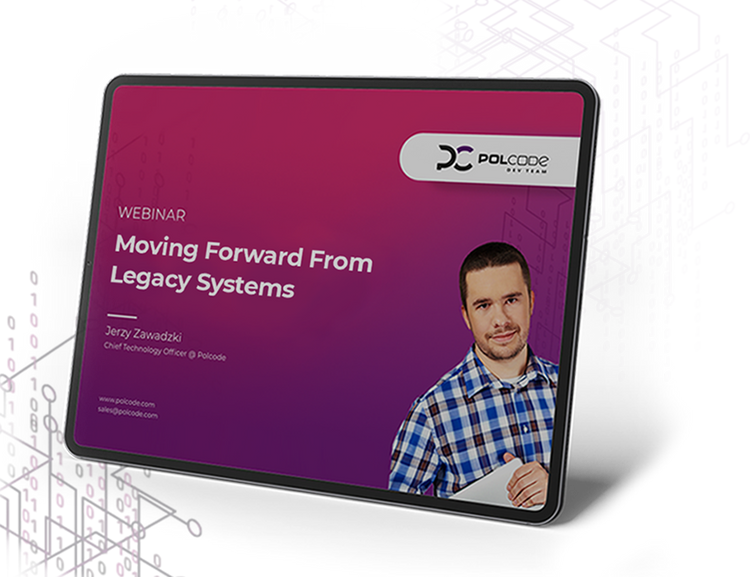
On-demand webinar: Moving Forward From Legacy Systems
Want to end legacy codebase misery and learn how to reignite your old IT system? Watch our on-demand webinar hosted by our CTO - Jerzy Zawadzki.
Latest Blog Posts
What a Product Delivery Manager Actually Owns in Max Price & Flexible Scope Delivery
Mar 25, 2026 by Joanna Karbowa
Model Comparison: Fixed Price vs Max Price & Flexible Scope vs Time & Material
Mar 18, 2026 by Karina Przybyłek
The Hidden Cost of Time & Material in the AI Era
Mar 11, 2026 by Sylwia Masłowska
Break Down Your Silos in 4 Simple Steps
Audit Your Current Systems & APIs
We’ll identify gaps, outdated endpoints, manual bottlenecks, and missing data flows.
Design a Modern Integration Layer
Our architects map your workflows and create a scalable API or middleware strategy.
Build Connectors & Automate Data Flow
From REST/GraphQL to event-driven architecture—we implement the tools that unify your stack.
Test, Optimize & Future-Proof
You get secure, documented, high-performance integrations ready for AI, automation, and growth.