


The choice of a delivery model directly influences how risk is distributed, how governance is structured, and how investment predictability is managed throughout a project.
These models are often discussed in terms of flexibility or pricing, but their deeper impact lies in how they shape incentives and accountability across the project lifecycle.
This article outlines the characteristics of three commonly used delivery models: Time & Material, Fixed Price & Fixed Scope, and Max Price & Flexible Scope, and examines when each model may be appropriate.
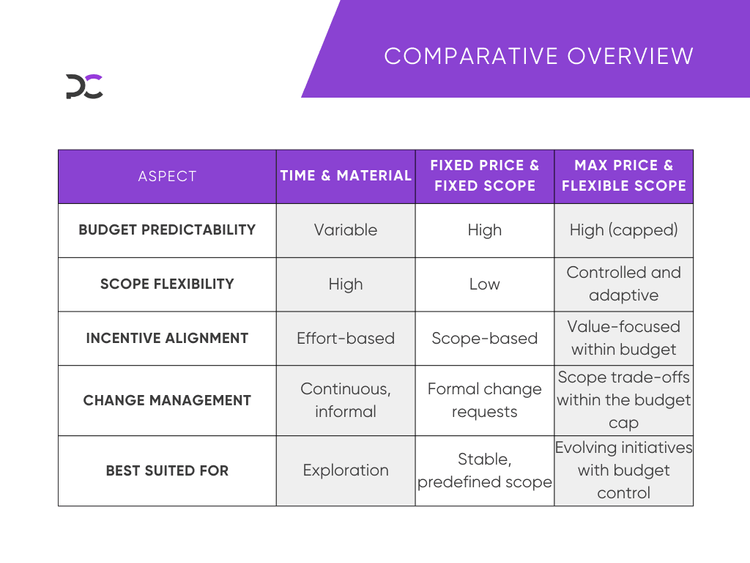
Model Comparison: Fixed Price vs Max Price & Flexible Scope vs Time & Material
The choice of a delivery model directly influences how risk is distributed, how governance is structured, and how investment predictability is managed throughout a project.
These models are often discussed in terms of flexibility or pricing, but their deeper impact lies in how they shape incentives and accountability across the project lifecycle.
This article outlines the characteristics of three commonly used delivery models: Time & Material, Fixed Price & Fixed Scope, and Max Price & Flexible Scope, and examines when each model may be appropriate.
Why the Delivery Model Matters
A delivery model determines:
how financial exposure is distributed,
how scope evolution is managed,
how prioritization decisions are made,
how efficiency gains translate into business value.
As software delivery incorporates AI-supported workflows, these differences become more visible. Commercial alignment must reflect operational realities.
→ For a broader discussion on why commercial alignment matters in AI-supported environments, see “The Hidden Cost of Time & Material in the AI Era”
Time & Material
Structural Characteristics
In a Time & Material model:
billing is based on time spent and resources allocated,
scope can evolve freely,
total cost remains variable.
This model offers operational flexibility. It allows projects to begin without fully defined requirements and supports ongoing adjustment as new information emerges.
When It Works Well
Time & Material may be appropriate when:
the primary objective is exploration,
uncertainty is intentionally accepted,
budget variability is not a critical constraint,
the client retains strong internal product governance.
In such contexts, flexibility outweighs financial predictability.
Structural Trade-Offs
However, the model distributes financial exposure primarily to the client. Without predefined financial boundaries, prioritization depends heavily on the maturity of internal governance.
→ For a deeper analysis of this risk structure, see “The Hidden Cost of Time & Material in the AI Era”
Fixed Price & Fixed Scope
Structural Characteristics
In a Fixed Price & Fixed Scope model:
budget is agreed upfront,
scope is precisely defined,
changes require formal renegotiation.
Financial predictability is high if requirements remain stable.
When It Works Well
This model is particularly effective when:
requirements are clearly documented,
the scope is unlikely to evolve significantly,
regulatory or compliance constraints require predefined deliverables,
timelines and outputs must be contractually locked.
In such cases, stability supports efficiency.
Structural Trade-Offs
The primary bottleneck lies in adaptability. When business priorities shift or new information emerges, formal change requests may slow down execution. The model assumes that the project value can be fully specified before development begins.
In rapidly evolving product environments, that assumption may not always hold.
Max Price & Flexible Scope
Structural Characteristics
Max Price & Flexible Scope combines a predefined financial boundary with flexible scope management.
A maximum budget is agreed at the outset.
Scope remains flexible within that limit.
Prioritization is continuous and explicit.
Trade-offs are managed within the budget cap rather than through contract renegotiation.
This model introduces financial predictability while preserving adaptability.
When It Works Well
Max Price & Flexible Scope is particularly suited to:
MVP development,
AI-supported delivery environments,
organizations that require budget control but cannot fully define scope in advance.
In these contexts, the model aligns financial discipline with adaptive product evolution.
Structural Trade-Offs
The model requires strong governance. Without structured oversight, a flexible scope within a capped budget can lead to misalignment or poor prioritization.
How AI Influences Model Selection
AI-supported workflows accelerate certain aspects of delivery while increasing the importance of review, validation, and architectural consistency.
In such environments:
models tied strictly to time may not fully reflect how value is created,
rigid scope assumptions may limit adaptability,
structured governance becomes central to balancing speed and discipline.
Organizations integrating AI into their delivery processes should therefore evaluate not only technical readiness but also commercial alignment.
→ For context on our transition away from T&M in Managed Delivery, see “Why We Said Goodbye to Time & Material in Managed Delivery and What It Means for You”
Selecting the Right Model
No delivery model is universally superior. Each represents a different balance between flexibility, predictability, and governance discipline.
The key questions client leadership teams should consider include:
How critical is budget predictability?
How likely is scope evolution?
How mature is internal product governance?
How important is alignment between efficiency gains and financial exposure?
The commercial structure of a delivery model shapes the behavior, incentives, and accountability on both sides of the partnership.
In AI-supported delivery environments, where time can be compressed and iteration cycles shortened, structural alignment between incentives, risk distribution, and governance becomes increasingly important.
Selecting the appropriate model is therefore less about preference and more about the strategic fit between delivery structure and business objectives.
On-demand webinar: Moving Forward From Legacy Systems
We’ll walk you through how to think about an upgrade, refactor, or migration project to your codebase. By the end of this webinar, you’ll have a step-by-step plan to move away from the legacy system.
Latest Blog Posts
The Hidden Cost of Time & Material in the AI Era
Mar 11, 2026 by Sylwia Masłowska
Heroku in “Sustaining Engineering” Mode – What It Technically Means and When to Consider Migration
Feb 27, 2026 by Jerzy Zawadzki
AI-Powered Search for Healthcare LMS: A Proof of Concept Journey
Feb 18, 2026 by Marta Kozłowska
Rethink Your Software Delivery Model
Assess Your Current Delivery Structure
Understand how your current commercial model distributes risk, incentives, and accountability across the project lifecycle.
Evaluate the Impact of AI on Delivery Efficiency
Identify where AI is accelerating development and how those efficiency gains affect cost structures and project governance.
Explore Outcome-Aligned Delivery Models
Consider commercial frameworks that balance flexibility with financial predictability and align delivery incentives with business value.