


Modern digital systems are expected to be fast, secure, scalable, and reliable.
Yet, many companies operate applications and websites that no longer provide full control, predictability, or confidence in further development, especially as systems grow, teams change, and business pressures increase.
This is where a Quality Audit becomes a strategic tool.
In this article, we explain:
What is a Quality Audit, really?
When does it bring the greatest value?
How do ISO 9001 and ISO 29119 impact software quality?
Why can a well-executed audit save time and money while reducing risk?
Application and Website Quality Audit: ISO 9001 and ISO 29119 Guide
Modern digital systems are expected to be fast, secure, scalable, and reliable.
Yet, many companies operate applications and websites that no longer provide full control, predictability, or confidence in further development, especially as systems grow, teams change, and business pressures increase.
This is where a Quality Audit becomes a strategic tool.
In this article, we explain:
What is a Quality Audit, really?
When does it bring the greatest value?
How do ISO 9001 and ISO 29119 impact software quality?
Why can a well-executed audit save time and money while reducing risk?
What Is an Application and Website Quality Audit?
A Quality Audit is a comprehensive, independent assessment of an application or website that evaluates not only the code, but also the processes and practices behind its development and maintenance.
While a Quality Audit looks at the entire system and development process, many companies start with a more focused code audit to understand the technical condition of their codebase.
At Polcode, audits are conducted in compliance with:
ISO 9001 – Quality Management Principles
ISO 29119 – Software Testing Standards
The audit covers all critical areas that influence system quality and long-term stability, including:
code quality and structure,
system architecture,
development and testing processes,
operational stability and performance,
security risks,
user experience (UX) and accessibility (optional modules),
documentation and communication practices.
The goal is not to point out isolated issues, but to provide a clear, objective picture of the system’s current state along with actionable recommendations for improvement.
What a Quality Audit Is and What It Is Not
A common misconception is that a Quality Audit is just:
a code review,
a penetration test,
or a checklist-based inspection.
In reality, a professional audit:
evaluates the system and the organization around it,
identifies root causes, not just symptoms,
and provides a decision-making foundation for future development.
The outcome is not a list of bugs, but a strategic diagnostic report.
Unlike a standard code audit, which focuses primarily on source code quality and maintainability, a Quality Audit also evaluates development processes, testing practices, and organizational maturity.
Why ISO 9001 and ISO 29119 Matter in Software Audits
ISO 9001 – Quality Management
ISO 9001 focuses on how work is organized and controlled.
In a software context, it answers questions such as:
Are development processes repeatable and predictable?
Is quality built into the process or fixed reactively?
Are responsibilities and communication clearly defined?
For businesses, this translates into:
fewer surprises,
better cost predictability,
and safer long-term scaling.
ISO 29119 – Software Testing
ISO 29119 defines best practices for software testing, including:
planning,
execution,
documentation,
and reporting.
It helps distinguish between:
testing that genuinely reduces risk,
and testing that only exists on paper.
Together, these standards ensure that audit recommendations are structured, measurable, and internationally recognized. This becomes critical in legacy environments, where outdated architectures and missing security updates significantly increase exposure to cyber threats.
When Does a Quality Audit Bring the Greatest Value?
A Quality Audit is most effective when used proactively, not only as a reaction to a crisis.
Typical scenarios include:
a change of CTO or other key technical stakeholders,
preparation for an investor round or company sale (technical due diligence),
declining performance, conversion rates, or SEO visibility,
recurring or hard-to-diagnose system errors,
the need to improve QA processes or introduce automated testing,
verification of software delivered by another vendor,
independent expert validation before further development or scaling.
In these cases, an audit provides clarity and reduces decision-making risk.
In many of these scenarios, companies initially commission a code audit to identify technical risks before moving toward a broader quality or process assessment.
This is especially true for organizations running legacy systems, where hidden security and compliance risks often remain undetected without a formal audit.
What Are the Benefits of a Quality Audit?
Companies that perform a Quality Audit gain:
Objective system assessment based on international standards.
Informed development decisions grounded in facts, not assumptions.
Improved security through early identification of vulnerabilities.
Better performance and stability, both technical and business-related.
Optimized development processes that prevent future errors.
Higher user satisfaction through improved UX and accessibility.
Predictable costs and roadmap thanks to clear, prioritized recommendations.
Case Studies: How Quality Audits Improve Software Projects
To illustrate the practical value of a Quality Audit, below are selected examples from projects audited by Polcode.
Client names are withheld due to confidentiality agreements, but each case reflects real audit scenarios and measurable outcomes.
Case 1: B2B Platform Without Formal QA Processes
Audit Scope:
Implementation of quality assurance processes in a project without structured testing practices.
Challenge:
The development team worked without formal QA standards, leading to recurring defects and unpredictable release quality.
Outcome:
introduction of structured QA and testing processes,
improved software development organization,
significantly reduced error rates in subsequent releases.
Case 2: E-commerce Platform With Checkout Stability Issues
Audit Scope:
Audit of the production environment focusing on issues in the purchasing flow.
Challenge:
Customers experienced errors during checkout, directly affecting conversion and revenue.
Outcome:
identification of critical processes and architectural gaps,
implementation of audit recommendations,
improved system stability and more reliable purchasing flow.
Case 3: SaaS Product With Inefficient Release Processes
Audit Scope:
Partial audit of software development and delivery processes.
Challenge:
Slow deployments and frequent production issues limited the team’s ability to deliver new features.
Outcome:
implementation of Kanban-based workflow,
improved release management processes,
faster deployments and fewer production errors.
Case 4: Enterprise System Requiring Technical and Process Validation
Audit Scope:
Audit covering code quality and software development process analysis.
Challenge:
The organization needed an independent assessment to validate the system’s technical condition and development practices.
Outcome:
comprehensive audit report,
clear, prioritized, and actionable recommendations,
solid foundation for further optimization and modernization.
Audit Process – How It Works
Stage 1: Current State Analysis
The audit team analyzes:
architecture and code quality,
development and testing processes,
documentation and internal communication,
system stability and risks.
Stage 2: ISO-Compliant Audit Report
The report includes:
references to ISO 9001 and the ISO 29119 family of software testing standards (ISO 29119-1 to ISO 29119-5),
identified issues and risks,
clearly described improvement recommendations.
Stage 3: Presentation of Recommendations
During a summary meeting, we present:
short-term improvements (quick wins),
mid-term process and technical optimizations,
long-term strategic recommendations.
The result is a clear, actionable roadmap.
Audit Scope and Available Options
Basic Audit
Scope:
code quality and architecture analysis
development and testing processes
ISO 9001 and ISO 29119 compliance
Duration: 40 hours (1 sprint)
Extended Audit Modules
The Basic Audit can be expanded with additional modules, depending on project needs.
1. UX/UI & Accessibility
interface usability and accessibility analysis
WCAG considerations
Duration: 60 hours (approx. 1.5 sprints)
2. Security
security configuration and vulnerability assessment
Duration: 72 hours (approx. 2 sprints)
For legacy applications in particular, regular security audits are often the first and most effective step toward reducing risk and planning modernization.
3. Security + Penetration Testing
vulnerability and risk analysis, including penetration tests
4. Marketing & Analytics
SEO, analytics, and marketing tools audit
Each audit is conducted by an interdisciplinary team, comprising QA specialists, developers, UX experts, and security engineers.
Who Performs the Audit?
Audits at Polcode are conducted by:
a certified ISO 9001 Lead Auditor,
supported by experienced developers, QA specialists, UX, and security experts.
This interdisciplinary approach ensures:
no blind spots,
no purely theoretical recommendations,
and conclusions grounded in real implementation experience.
Will the Audit Force Further Cooperation?
No.
The audit is:
independent,
objective,
and non-binding.
Clients use audit results to:
improve systems internally,
continue cooperation with current vendors,
or start implementation with Polcode.
The audit gives knowledge and control, not obligation.
Why Choose Polcode for a Quality Audit?
For nearly 20 years, Polcode has supported companies in building, enhancing, and modernizing digital systems.
What sets us apart:
audits conducted by a certified ISO 9001 Lead Auditor,
strong technical and consulting background,
practical recommendations focused on real business value,
the ability to support implementation after the audit, if needed.
We focus on quality over documentation and long-term partnership.
How to Get Started
The first step is a conversation:
about your system,
your business goals,
and the challenges you want to address.
Based on this, we propose the most effective audit scope.
Ready to Take Control of Your System?
If you are considering an application or website audit and want to determine whether it's a good fit for your specific situation, let’s discuss.
In many cases, a single audit uncovers issues that would otherwise result in months of rework or significant, avoidable costs.
Contact Polcode to discuss your Quality Audit.
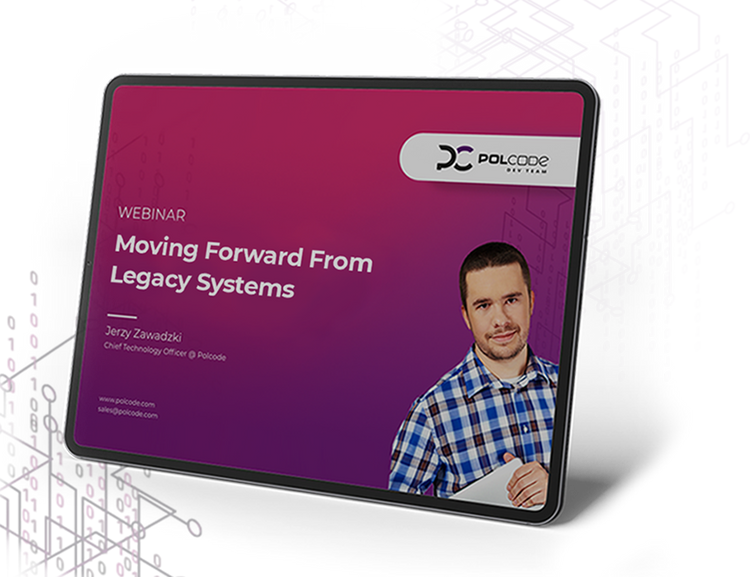
On-demand webinar: Moving Forward From Legacy Systems
We’ll walk you through how to think about an upgrade, refactor, or migration project to your codebase. By the end of this webinar, you’ll have a step-by-step plan to move away from the legacy system.
Latest Blog Posts
What a Product Delivery Manager Actually Owns in Max Price & Flexible Scope Delivery
Mar 25, 2026 by Joanna Karbowa
Model Comparison: Fixed Price vs Max Price & Flexible Scope vs Time & Material
Mar 18, 2026 by Karina Przybyłek
The Hidden Cost of Time & Material in the AI Era
Mar 11, 2026 by Sylwia Masłowska
Assess Your System
Select the Audit Scope
Start with a code audit or extend it to quality, security, or UX.
Get an ISO-Based Audit
Receive an independent assessment aligned with ISO 9001 and ISO 29119.
Make Informed Decisions
Use clear recommendations to plan next steps with confidence.