

AI coding tools are transforming engineering. The real risk is not the tools themselves, but how we use them.
In her article “Why at Polcode, We Treat AI as a Strategic Layer, Not Just a Tool”, our CSO outlined why AI has become a structural part of our operating model. She explained how AI influences time, cost, risk, and value delivery. That is the strategic layer, essential, but only half of the story.
The second half begins where strategy ends, and daily engineering work starts. At this point, the question “why AI?” gives way to far more difficult ones: how AI changes the way we build software, and what risks emerge when engineering processes are not ready for it.
This article describes what happens inside engineering teams when AI coding tools become a standard part of work.
AI Won’t Fix Your Engineering Process. It Will Expose It
AI coding tools are transforming engineering. The real risk is not the tools themselves, but how we use them.
In her article “Why at Polcode, We Treat AI as a Strategic Layer, Not Just a Tool”, our CSO outlined why AI has become a structural part of our operating model. She explained how AI influences time, cost, risk, and value delivery. That is the strategic layer, essential, but only half of the story.
The second half begins where strategy ends, and daily engineering work starts. At this point, the question “why AI?” gives way to far more difficult ones: how AI changes the way we build software, and what risks emerge when engineering processes are not ready for it.
This article describes what happens inside engineering teams when AI coding tools become a standard part of work.
The Myth of Vendor Lock-In — the Easiest Problem to Solve
AI discussions often start with concerns about dependency on a single provider: price changes, single points of failure, evolving security policies, or differences in model quality. These are natural questions, but from an engineering standpoint, they are far less critical than they appear.
Model-generated code does not depend on any particular runtime, and API standards are now consistent enough that switching providers requires no architectural refactoring, only integration-layer adjustments. With a multi-provider setup, an abstraction gateway, and local compilation, these risks can be reduced to a minimum.
Vendor lock-in is the most manageable form of risk.
The far bigger risk lies elsewhere.
The Real Lock-In: Erosion of Skills and Process Maturity
Much harder is a different kind of lock-in: the one that forms inside the team itself.
When engineers begin to assume that “AI will do everything”, analytical, design, and diagnostic skills erode. Teams appear to deliver faster, but beneath the surface, the organization becomes technically weaker. This competency debt is invisible in the short term, which is precisely why it is dangerous.
The real problem appears only when we stop talking about vendors and start looking inside the engineering process.
AI Amplifies Whatever It Finds — Process or Chaos
When a project is well documented, the architecture and requirements are expressed in the repo in a versionable form, AI becomes a powerful accelerator.
But if basic engineering practices are not in order, AI accelerates not only work, but also error creation. Models don’t create chaos, but they reveal the chaos that already exists by materializing it faster.
This is why we emphasize spec-as-code: architectural documentation, system contracts, domain files, and requirement specs all need to live in the repository, versioned, consistent, and readable not only to humans but also to models. Only then can AI behave predictably, because it operates on context that accurately reflects the project.
Otherwise, models start guessing, and guessing inside complex systems produces only the illusion of correctness.
At that point, the question becomes: who is actually in control — the engineer or the model?
Workflow Matters More Than Tools
Whether a team uses Copilot, Cursor, Windsurf, or an on-premise model is secondary. What matters is how AI is embedded into the engineering workflow.
At Polcode, we follow a principle: AI supports the process, but does not lead it.
This is why we work in a co-pilot mode: AI may propose, analyze, or accelerate, but it never decides. The specific tool is irrelevant; the principle is that humans maintain ownership of reasoning, decision-making, and accountability.
We promote a reading-first approach, which forces understanding over passive acceptance. Working with AI requires more precision, not less. Models perform well only when instructions are precise. This forces developers to formulate requirements clearly, understand context deeply, and consciously manage information flow.
Contrary to common fears, AI does not simplify thinking; it structures engineering.
Engineering Controls That Prevent Chaos
The business benefits of AI, predictability, stability, and speed depend on engineering maturity.
The role of the CTO is ensuring that AI does not generate technical debt faster than the organization can absorb it.
This is why it is crucial to build processes that shape AI-assisted work. In our case, these include:
architectural and domain descriptions stored in the repo (e.g., architecture.md, domain.md),
context rules for AI tools and engineering instructions that guide model behavior,
prompt-construction standards aligned with the system architecture,
security guidelines for sensitive and regulated data,
code review principles explicitly addressing AI-generated code,
a multi-provider environment with fast provider switching.
Each of these components is part of a larger whole, a working system that relies not on the tool, but on organizational maturity.
Monitoring Effectiveness Is Not Control; It Is a Process Evaluation
Questions about monitoring AI usage come up often. But it is not about tracking who used which tool and when.
The real indicators are always outcomes:
stability of delivered code,
number of iterations needed to reach correctness,
delivery speed without compromising quality,
quality of architectural decision-making.
Differences of three- to five-fold in developer speed rarely come from tool choice alone. They come from how well people can use the tools and how well they understand the project.
In this sense, AI performance becomes a proxy for evaluating engineering maturity.
Regulated Industries Show What “Good AI Environments” Look Like
Industries like healthcare, fintech, and insurance are often seen as risky environments for AI. The paradox is that models perform best exactly in those environments. Not because the tools are different, but because the context is structured.
Documentation, processes, data flows, and standards are clearly defined. This is the environment in which AI can fully leverage its analytical capabilities.
When context is precise, models stop guessing. They start analyzing.
Vendor Resilience Is a Side Effect of Engineering Maturity
What people often call “zero vendor lock-in” does not come from using multiple tools. It comes from an engineering process designed so that no single point, tool, provider, or service becomes a deciding factor.
Good architecture remains resilient regardless of model changes.
Bad architecture stays brittle no matter how many providers are integrated.
Resilience is therefore a consequence of maturity: standards, architecture, processes, and documentation first, tools second.
Summary: AI will not build your engineering culture. It will only reveal whether you have one
AI coding tools accelerate work, improve analysis, and stabilize delivery, but only if there is a process that supports them. If there isn’t, AI will not fix anything. It will merely accelerate the moment when problems become visible.
This is why discussions often focus on vendors and models, while the biggest risks come from engineering culture: whether a team can work deliberately, precisely, and responsibly, regardless of how advanced the tool is.
At Polcode, we treat AI as a strategic layer. But from an engineering perspective, it is equally important to recognize that AI requires process maturity, not technological enthusiasm. AI will not replace good architecture, disciplined design, or thoughtful engineering. Without these foundations, no model, no matter how advanced, creates real advantage.
Explore how Polcode integrates AI as a strategic delivery layer and builds predictable, accountable software delivery.
This is why we view AI not as a way to automate work, but as a stress test of process stability. And we invest not in tools, but in the engineering culture that makes those tools meaningful.
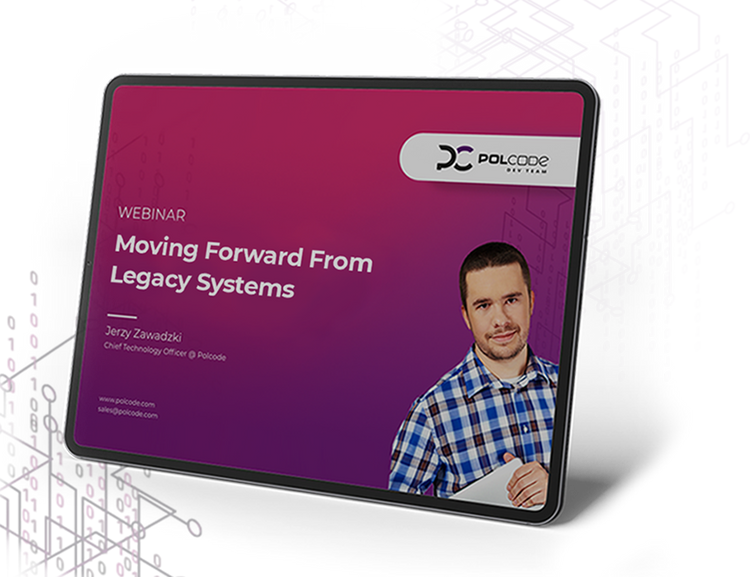
On-demand webinar: Moving Forward From Legacy Systems
We’ll walk you through how to think about an upgrade, refactor, or migration project to your codebase. By the end of this webinar, you’ll have a step-by-step plan to move away from the legacy system.
Latest Blog Posts
What a Product Delivery Manager Actually Owns in Max Price & Flexible Scope Delivery
Mar 25, 2026 by Joanna Karbowa
Model Comparison: Fixed Price vs Max Price & Flexible Scope vs Time & Material
Mar 18, 2026 by Karina Przybyłek
The Hidden Cost of Time & Material in the AI Era
Mar 11, 2026 by Sylwia Masłowska
Ready to Talk About Your Project?
Tell Us More
Fill out a quick form describing your needs. You can always add details later on and we’ll reply within a day!
Strategic Planning
We go through recommended tools, technologies and frameworks that best fit the challenges you face.
Workshop Kickoff
Once we arrange the formalities, you can meet your Polcode team members and we’ll begin developing your next project.