

Artificial intelligence is part of everyday software delivery. It supports planning, analysis, documentation, coding, testing, and communication. What is still missing in many organizations is not access to AI tools, but a clear definition of how responsibility, data protection, and accountability work once AI is involved.
AI adoption is often discussed in terms of speed and efficiency. Much less attention is paid to governance, even though, in practice, governance determines whether AI reduces risk or quietly amplifies it.
At Polcode, we see this very clearly. Using AI without explicit rules is not innovation. It is an assumption that everything will “work out somehow”. That is why we created and published our AI Usage & Safety Policy.
This article explains why we made that decision, what the policy actually changes in daily delivery work, and how governance becomes a core part of an AI-supported delivery model.
AI Usage & Safety Policy: Why Responsible AI Needs Rules, Not Assumptions
Artificial intelligence is part of everyday software delivery. It supports planning, analysis, documentation, coding, testing, and communication. What is still missing in many organizations is not access to AI tools, but a clear definition of how responsibility, data protection, and accountability work once AI is involved.
AI adoption is often discussed in terms of speed and efficiency. Much less attention is paid to governance, even though, in practice, governance determines whether AI reduces risk or quietly amplifies it.
At Polcode, we see this very clearly. Using AI without explicit rules is not innovation. It is an assumption that everything will “work out somehow”. That is why we created and published our AI Usage & Safety Policy.
This article explains why we made that decision, what the policy actually changes in daily delivery work, and how governance becomes a core part of an AI-supported delivery model.
Why AI Governance Is Becoming a Delivery Requirement
AI changes how work is done, but it does not change who is responsible for the outcome. Code quality, system stability, data protection, and contractual obligations do not disappear simply because part of the work was AI-supported.
Without clear rules, several risks emerge quickly:
responsibility becomes unclear,
data handling depends on individual judgment,
teams use tools inconsistently,
clients lack transparency into delivery practices.
In long-term or regulated projects, this uncertainty becomes a real operational and business risk.
From our perspective, AI governance is not a legal safeguard added at the end of a project. It is part of the delivery model itself. If AI is present in daily work, governance must be present as well.
AI at Polcode: A Delivery Layer, Not an Experiment
At Polcode, AI is not treated as an individual productivity hack or a side experiment. It is embedded into software delivery as a strategic delivery layer that operates within clearly defined and continuously evolving delivery processes, documentation, and human decision-making.
In practice, this means that AI:
is integrated into defined workflows,
supports, but does not replace, expert judgment,
remains tool-agnostic,
is always subject to human review and ownership.
To make this approach scalable across teams and projects, rules had to be explicit rather than assumed. The AI Usage & Safety Policy provides that structure.
What AI Usage & Safety Policy Changes in Daily Delivery
The policy defines how AI can be used across client projects and internal operations. Its purpose is not to restrict teams, but to ensure consistency, safety, and accountability.
Human responsibility remains central
Every AI-supported output, whether it is code, documentation, analysis, or recommendations, is reviewed, tested, and approved by people. Decisions and accountability never move to the tool. AI assists delivery. It does not own it.
Ownership does not shift to tools or vendors
Regardless of which AI tools are used, Polcode teams remain fully responsible for delivered outcomes. There is no transfer of accountability to models, platforms, or third-party providers.
This principle is fundamental to maintaining trust and long-term delivery quality.
Data protection is treated as an operational standard
Sensitive client data is never entered into public or uncontrolled AI systems. Where AI support is used, data is anonymized or sanitized according to clearly defined rules.
Data protection is handled as a day-to-day operational requirement, not as an abstract guideline.
Tooling is business-grade and continuously reviewed
AI tools are selected deliberately and reviewed from security, legal, compliance, and operational perspectives. Only business-grade, vetted solutions are used.
This allows teams to work efficiently without introducing hidden technical or legal risk.
Clients retain full transparency and control
Clients are informed about how AI is used in delivery and explicitly approve its usage. They always retain the right to opt out. Transparency is the default, not a special case.
Why We Chose to Publish the Policy Publicly
We decided to publish our AI Usage & Safety Policy externally because AI governance should not be hidden behind NDAs.
Clients increasingly ask not only whether AI is used, but:
where it is used,
how their data is protected,
who is responsible for outcomes.
Making the policy public removes ambiguity and sets clear expectations. It also reflects how AI is already used in our daily delivery work.
Governance as an Enabler, Not a Limitation
There is a common belief that rules slow teams down. Our experience shows the opposite.
Clear governance:
reduces uncertainty,
limits rework,
supports repeatability,
enables scaling across teams.
When teams share standards and boundaries, they can work faster without improvisation. Responsible AI usage makes delivery more predictable, not less.
AI as a Long-Term Capability
AI adoption at Polcode is part of a broader transformation effort focused on evolving delivery processes, documentation, ownership, and long-term delivery quality. The AI Usage & Safety Policy is one of the foundations of that approach.
Our goal is to use AI responsibly, consistently, and at scale.
This policy is one element of a broader, long-term transformation of how we deliver software with AI.
→ Explore our full AI approach and delivery model.
Frequently Asked Questions
Does this policy slow down delivery?
No. In practice, it reduces friction. Clear rules remove uncertainty around data handling, responsibility, and review requirements, which lowers the risk of rework and late-stage corrections.
Are developers allowed to use AI freely?
AI usage is allowed within defined guidelines. Teams know which tools are approved, how data must be handled, and where human review is mandatory. This enables daily use without improvisation.
Is client data ever shared with AI models?
Sensitive client data should not be entered into public or uncontrolled AI systems. Where AI support is used, data is anonymized or sanitized according to the policy.
Who is responsible for AI-generated outputs?
Polcode teams are fully responsible for all delivered work, regardless of whether AI tools were used. Responsibility does not shift to vendors or models.
Can clients opt out of AI usage?
Yes. Clients are informed about AI usage and explicitly approve it. They always retain the right to opt out.
Is the policy static?
No. The policy is reviewed and updated continuously as tools, regulations, and best practices evolve.
Final Thought
AI will continue to shape how software is built. Organizations that treat governance as optional will eventually pay for it in risk, technical debt, or loss of trust.
Read the full AI Usage & Safety Policy.
Polcode Editorial
This article represents Polcode’s collective perspective on AI adoption, based on strategic, operational, and engineering experience across the organization.
Explore the Polcode AI Hub
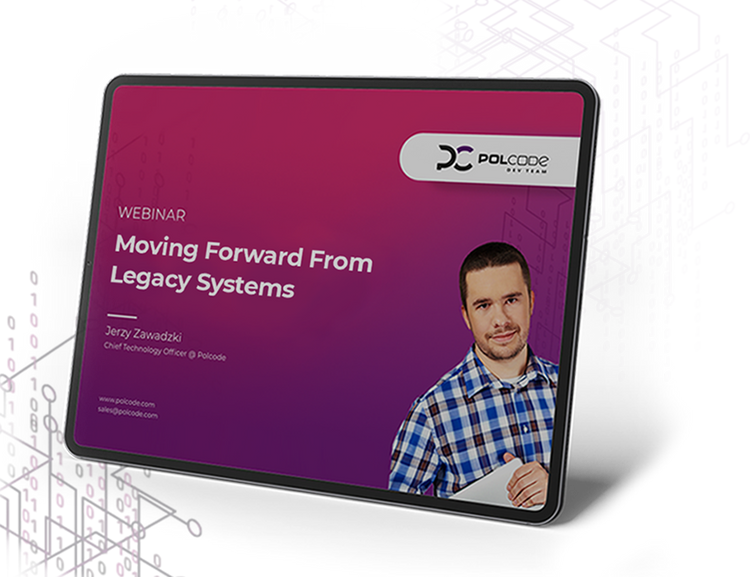
On-demand webinar: Moving Forward From Legacy Systems
We’ll walk you through how to think about an upgrade, refactor, or migration project to your codebase. By the end of this webinar, you’ll have a step-by-step plan to move away from the legacy system.
Latest Blog Posts
What a Product Delivery Manager Actually Owns in Max Price & Flexible Scope Delivery
Mar 25, 2026 by Joanna Karbowa
Model Comparison: Fixed Price vs Max Price & Flexible Scope vs Time & Material
Mar 18, 2026 by Karina Przybyłek
The Hidden Cost of Time & Material in the AI Era
Mar 11, 2026 by Sylwia Masłowska
Accelerate, Secure, and Improve Your Project with AI
Learn how AI boosts delivery predictability
Discover our approach to managing processes and reducing risks.
Leverage AI to shorten delivery cycles
See how automating repetitive tasks lets teams focus on decisions and analysis.
Ensure higher quality without extra effort
Find out how human expertise combined with AI raises your project standards.