


Artificial intelligence is reshaping how software is planned, built, and delivered.
At Polcode, AI is not a tool experiment, but a structured delivery layer, embedded into strategy, engineering, and operations, governed by clear rules and human accountability.
This page is the central reference point for how Polcode approaches AI adoption in software delivery.
It brings together our strategic perspective, engineering experience, transformation framework (RE:WORK), and AI Usage & Safety Policy into one coherent model.
Everything described here is based on real project work, real constraints, and real delivery accountability.
Our approach is supported by formal governance standards, including an externally published AI Usage & Safety Policy.
AI in Software Delivery: How Polcode Builds Predictable, Responsible, AI-Supported Systems
Artificial intelligence is reshaping how software is planned, built, and delivered.
At Polcode, AI is not a tool experiment, but a structured delivery layer, embedded into strategy, engineering, and operations, governed by clear rules and human accountability.
This page is the central reference point for how Polcode approaches AI adoption in software delivery.
It brings together our strategic perspective, engineering experience, transformation framework (RE:WORK), and AI Usage & Safety Policy into one coherent model.
Everything described here is based on real project work, real constraints, and real delivery accountability.
Our approach is supported by formal governance standards, including an externally published AI Usage & Safety Policy.
What you’ll find on this page
On this page you’ll find:
how we treat AI as a strategic delivery layer, not a standalone tool,
how the RE:WORK program structures AI adoption across teams,
how AI changes engineering work in practice,
how we balance speed, scale, and long-term quality,
how safety, compliance, and accountability are enforced,
what this approach means for our clients and delivery outcomes.
Delivery Foundations, Reworked
AI changes how processes, documentation, architecture, and human decisions are structured and executed. Its impact depends directly on how consciously these elements are redesigned to support AI-assisted and automated work.
From our experience:
teams with mature, well-documented processes gain speed and predictability,
inconsistent or undocumented workflows lead to faster accumulation of issues,
unclear ownership increases delivery risk rather than productivity.
These observations shaped our approach to AI adoption across the organization.
Why this matters: AI amplifies both the quality of existing processes and the consequences of how they are redesigned.
AI as a Strategic Delivery Layer
At Polcode, delivery is redesigned around AI-supported and automated workflows, where AI becomes a structural component of how work is done.
In practice, this means:
workflows are redefined to incorporate AI-supported and automated steps where they add real value,
usage follows shared standards and guidelines,
processes remain tool-agnostic,
human review, decision-making, and responsibility remain an explicit and mandatory part of the system.
From a business perspective, this approach supports:
reduced delivery risk,
improved predictability,
faster time-to-value,
outcome-based delivery models.
Why this matters: Treating AI as a delivery layer enables scale without sacrificing accountability.
→ Related perspective: Why at Polcode, We Treat AI as a Strategic Layer, Not Just a Tool
From Strategy to Practice: the RE:WORK Program
To make AI adoption repeatable and scalable, we launched RE:WORK, a structured transformation program focused on redesigning software delivery and development around AI-supported work.
The Onboard Phase — Preparing for AI Adoption
The Onboard phase concentrates on readiness and includes:
forming a cross-functional transformation team,
identifying repetitive, low-creativity tasks,
selecting and reviewing AI tools,
distributing access with clear usage guidelines,
designing and testing AI-supported workflows.
This structure allows AI to be introduced on stable foundations and evaluated continuously.
Why this matters: Structured onboarding allows new delivery models to scale without relying on individual experimentation.
→ Deep dive: RE:WORKING How Software Is Built: Inside Polcode’s AI Transformation
Engineering Reality: How AI Changes Daily Work
In engineering teams, AI significantly alters the distribution of time and attention.
Reduced time spent writing code is accompanied by increased time spent on:
reviewing generated output,
understanding behavior and side effects,
validating correctness and security,
maintaining architectural coherence.
AI delivers meaningful results when it operates on precise input:
clear requirements,
explicit constraints,
versioned documentation,
well-defined system boundaries.
Without these elements, quality and stability become harder to maintain.
Why this matters: AI shifts engineering effort from writing code to understanding, reviewing, and validating systems.
→ Engineering perspective: AI Won’t Fix Your Engineering Process. It Will Expose It
Managing Speed, Scale, and Long-Term Quality
AI enables rapid generation of code and artifacts. This creates new operational risks when speed is not balanced with discipline.
To manage this, we:
generate smaller, controlled units of work,
explicitly account for analysis and review time,
maintain strict documentation and quality standards,
keep decision-making and accountability with people.
These practices help avoid long-term complexity growth and uncontrolled technical debt.
Why this matters: Without discipline, AI accelerates technical debt instead of reducing it.
→ Read more: AI-Generated Code: Say Hello to Legacy 2.0
Safety, Compliance, and Responsible AI Usage
Responsible AI usage is a delivery standard at Polcode and applies to both client projects and internal operations.
Our approach is based on clear governance rules that define how AI is used, reviewed, and controlled in daily work.
Key principles include:
human-in-the-loop as a mandatory standard for all AI-supported work,
full ownership of outputs by Polcode teams, regardless of tool usage,
strict data sanitization and anonymization rules,
exclusive use of business-grade AI tooling,
explicit client approval and the ability to opt out,
continuous legal, security, and compliance review.
These rules are formalized in our external AI Usage & Safety Policy, which describes how we protect client data, manage risk, and ensure accountability across the delivery lifecycle.
Our AI Usage & Safety Policy is a delivery standard applied in daily work across projects and teams.
→ Read the full policy: Polcode AI Usage & Safety Policy
What This Means for Our Clients
For clients, this approach changes not what we promise, but how reliably we deliver.
Our AI approach focuses on three areas of client value:
Faster value
Shorter delivery cycles, quicker validation, and earlier risk detection.
Lower risk
Clearer requirements, better documentation, and fewer late-stage surprises.
Higher quality without higher workload
Reduced repetitive work allows experts to focus on analysis, decisions, and problem-solving.
AI supports expert work by increasing focus and consistency.
Where We Are Heading
AI adoption at Polcode is an ongoing process.
Next phases of RE:WORK focus on:
scaling validated AI workflows across teams,
increasing organizational AI maturity,
embedding AI-native practices into standard delivery.
Our objective is to maintain a predictable, responsible, and scalable delivery model, redesigned around AI-supported and automated work, with human accountability at its core.
Final Note
AI adoption at Polcode is driven by delivery realities, market expectations, and operational data. It reflects a long-term commitment to building software in a way that supports quality, accountability, and sustained value creation.
Polcode Editorial
This article represents Polcode’s collective perspective on AI adoption, based on strategic, operational, and engineering experience across the organization.
Explore the Polcode AI Hub
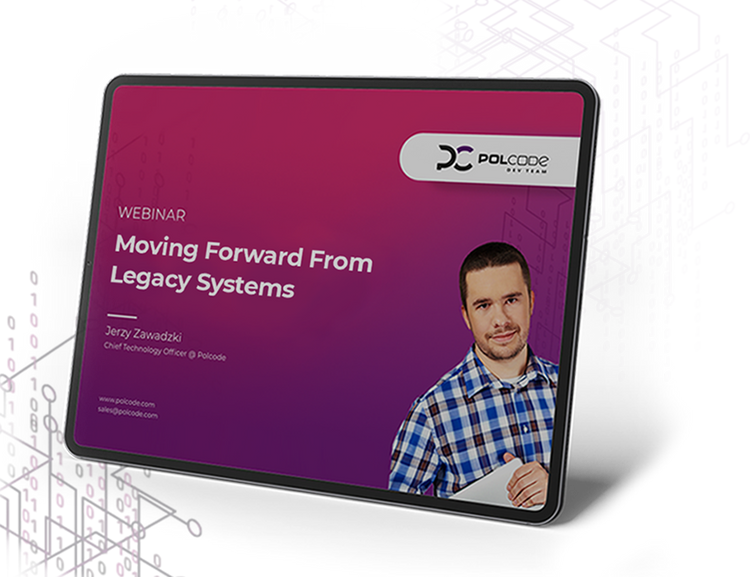
On-demand webinar: Moving Forward From Legacy Systems
We’ll walk you through how to think about an upgrade, refactor, or migration project to your codebase. By the end of this webinar, you’ll have a step-by-step plan to move away from the legacy system.
Latest Blog Posts
Accelerate, Secure, and Improve Your Project with AI
Learn how AI boosts delivery predictability
Discover our approach to managing processes and reducing risks.
Leverage AI to shorten delivery cycles
See how automating repetitive tasks lets teams focus on decisions and analysis.
Ensure higher quality without extra effort
Find out how human expertise combined with AI raises your project standards.