The Hidden Cost of Time & Material in the AI Era
MAR. 11, 2026, Sylwia Masłowska
7 min read

Time & Material (T&M) has long been the dominant commercial model in software development. It emerged in response to uncertainty: when the project scope could not be fully defined upfront, T&M offered a practical way to initiate collaboration and adjust delivery as new information became available.
Commercial models, however, are not neutral. They influence incentives, determine how financial risk is distributed, and shape governance structures throughout the delivery process.
For years, the economic logic of T&M was rarely questioned. Billing for time spent appeared to reflect how engineering work actually happened: progress followed effort.
Artificial intelligence is now challenging that assumption.
AI-supported development accelerates prototyping, reduces repetitive tasks, and compresses iteration cycles. As a result, the relationship between effort and delivered value is becoming increasingly non-linear.
This shift raises an important question:
When technology enables faster delivery, does a billing model built around billable hours still align incentives between vendor and client?
At Polcode, this question led us to reassess how commercial structures support long-term delivery partnerships. In Managed Delivery engagements, we have formally moved away from traditional T&M toward a model we call Max Price & Flexible Scope, designed to preserve agility while introducing financial boundaries and stronger alignment around outcomes.
In a Time & Material model, compensation is directly proportional to time spent and resources allocated. Scope can evolve freely, but total cost remains variable. Financial exposure is therefore largely borne by the client, while the vendor’s revenue scales with duration and team size.
In practical terms, this means that when delivery takes longer, the vendor’s revenue increases. When efficiency improves and work is completed faster, fewer billable hours are generated. While delivery teams typically operate in good faith, the commercial structure itself creates a structural tension between efficiency and revenue.
This model can function effectively in exploratory contexts where uncertainty is intentionally accepted. However, as projects grow in complexity and investment increases, open-ended financial exposure introduces challenges in forecasting, prioritization, and long-term accountability.
The visibility of hourly rates often creates a perception of transparency. Yet transparency of unit cost does not equate to predictability of total investment. When scope, duration, and efficiency remain fluid, the total cost often becomes clear only late in the project.
A broader comparison of how Time & Material differs from Fixed Price and Max Price & Flexible Scope models is outlined in our separate analysis of delivery model structures.
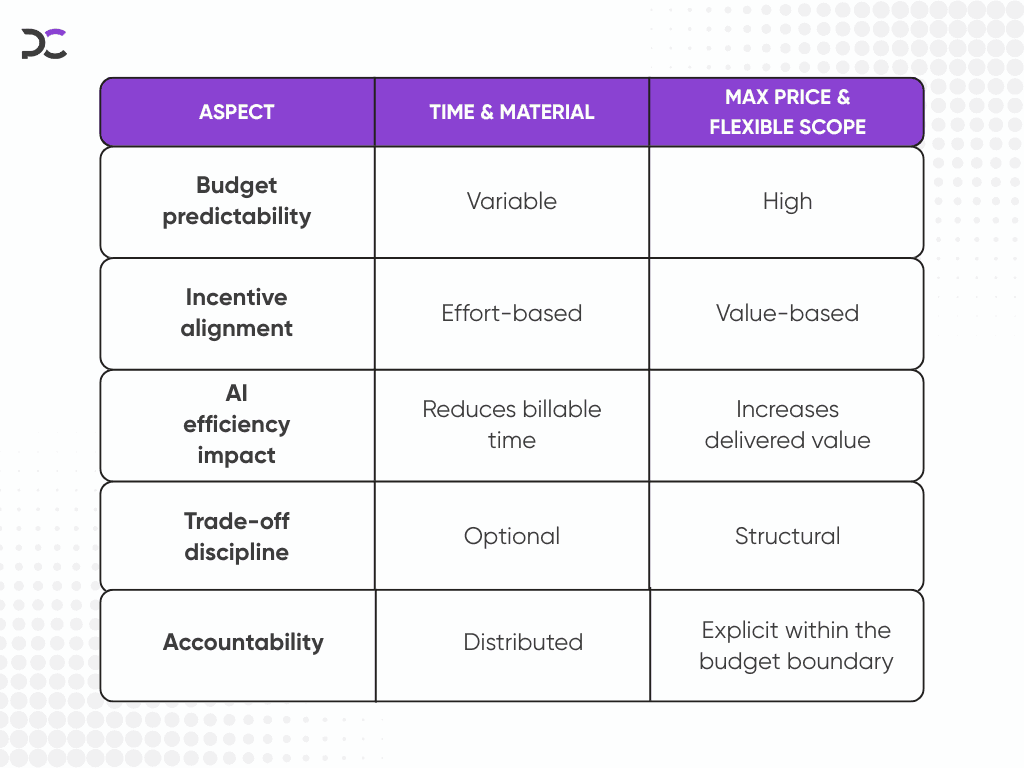
In environments where technology accelerates delivery, these structural differences become increasingly important. Models tied directly to billable effort may struggle to align incentives when engineering productivity continues to increase.
Rethink Your Software Delivery ModelRethink Your Software Delivery Model

Assess Your Current Delivery Structure
Understand how your current commercial model distributes risk, incentives, and accountability across the project lifecycle.
Evaluate the Impact of AI on Delivery Efficiency
Identify where AI is accelerating development and how those efficiency gains affect cost structures and project governance.
Explore Outcome-Aligned Delivery Models
Consider commercial frameworks that balance flexibility with financial predictability and align delivery incentives with business value.

On-demand webinar: Moving Forward From Legacy Systems
We’ll walk you through how to think about an upgrade, refactor, or migration project to your codebase. By the end of this webinar, you’ll have a step-by-step plan to move away from the legacy system.
Sign up for the Latest PolCode News
Subscribe
Latest Blog PostsLatest Blog Posts


Let’s Look at What You’re Dealing with!
Whether you’re starting fresh or trying to fix what’s already in motion — the first step is a conversation. No pitch, no pressure. Just an honest look at your situation and what makes sense next.